
Step 1 of 3
Build supports
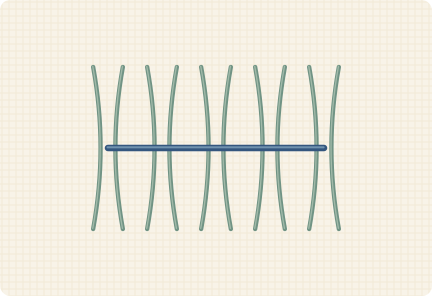
Hemstitch both edges into equal bundles. Lay a light foundation thread across the center where the wheel will sit.
Use the threads that remain in an open band as the supports for woven bars and little wheels.
Work the steps ↓ Browse 14 techniques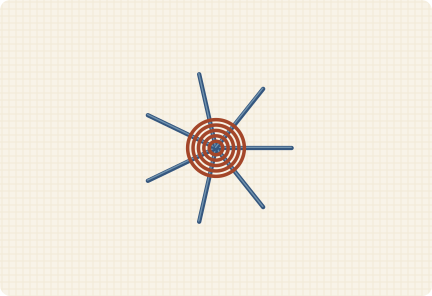
Hemstitch both edges into equal bundles. Lay a light foundation thread across the center where the wheel will sit.
Weave back and forth through a group of supports. Reverse the over-under order at each turn.
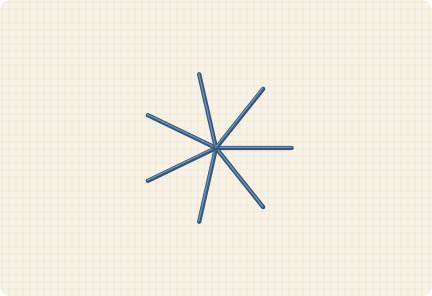
At a crossing work around the radiating supports in order. Pack each circuit against the last without closing the surrounding holes.
One spoke has more slack than its opposite. Adjust the foundation before packing the next circuit.
Draw out from eight to twelve threads, according to the quality of the fabric. Insert your needle and thread between two clusters, and pass it, as if you were darning, backwards and forwards over them, until they are encased half way down with stitches. In so doing, work with the eye of the needle forward, and the point towards your thimble. To pass to the next cluster, take one stitch back, under the one just darned, and bring your thread underneath the threads of the fabric, to the second cluster.
Every cross-line of three clusters is to be worked in one colour. The colours may all be different, or you may if you prefer, take shades of the same colour.
Overcast the two boundaries of a small withdrawn band. Work short darning passes over a group of foundation strands, reversing the over-under order on the return. Pack them together with the blunt needle until the ground disappears inside the filled shape.
After drawing out sixteen or eighteen threads, bind both sides with stitches made over four horizontal and four perpendicular threads, as follows; make one back-stitch over four disengaged threads, then bring up your thread from right to left, over four horizontal and under four perpendicular threads, back over the four last threads, and draw it out beside the next cluster. The thread must be fastened in and cut off, after each group is finished.
Then make the darning stitch over nine threads, or three clusters. At half their length, you leave out three threads, first on the right, then on the left, while in the other half, you, in a similar manner, take in three; so that you have two darned and two undarned clusters, standing opposite each other.
Draw out twenty threads, overcast both edges with stitches, made over three threads. Then, make slanting stitches, proceeding out from these, over three, six and nine threads respectively, all three terminating in a perpendicular line, one below the other.
For the open-work, twist the thread five times, quite tightly round and round one cluster, bring it to the edge, between the second and third clusters, and connect these by means of six darning-stitches back and forth: join the first and second clusters in the same way by twelve stitches, and finish, by twisting the thread five times round the remaining length of the first cluster. The second half of the open-work figure is carried out in a similar manner over the third and fourth clusters.
Draw out, from twenty-five to thirty threads. Each of the middle figures combines three clusters of the two figures above it, and may be executed, either in a different colour altogether, or in a lighter shade of the one employed in the top row. The little star in the centre should be worked in dark red, or black.
For each of these draw out forty threads. Begin at the top of the big pyramid, so that the threads which you run in, can be more closely crowded together.
Lso is to be worked in three colours; the light squares in unbleached cotton, the middle figure in Bleu-Indigo très clair, 334, the large squares on either side in Brun-Cuir clair 432.
In the middle, the so-called spiders are made, over every group of four clusters. The thread that runs out from the spider, passes over two clusters and under one, and then three or four times, over and under the clusters, as in darning, and so back, under the spider, at the place at which it was drawn in, and then on, to the next four strands of thread.
Draw out five threads for the narrow stripe, and from fourteen to sixteen for the wide one. Then unite each separate cluster in the middle, with a back-stitch, and finally, join every group of four clusters together, with three stitches, and make a spider in the middle of the open-work, at the point where the threads intersect each other.
Draw out, from twenty-four to thirty threads. Wind your thread six or seven times round the middle of each cluster of nine threads, and then make darning-stitches, above and below, to a length of 3 mm When you have completed two clusters, join them together, by four interlocked stitches; wind your thread three times round the single thread, and sew it over with close stitches.
Mark an even group of supports beside the edge of a withdrawn band. Begin a half wheel over two supports, adding neighboring supports until eight are included. Compare the edge fan with a whole wheel worked around a center in the open channel.
The beauty of this otherwise simple pattern, lies in the peculiar knot, with which the edges of the fabric are ornamented.
Carry the working thread, from right to left, (see the description of the right side) over and under four threads; then bring the needle back, under the thread which lies slanting, form a loop with the forefinger of the left hand, slip it on to the needle, and draw it up close to the first stitch; pull the needle through the knot, and proceed to the next stitch.
For this pattern, which is a very laborious one to work, draw out twenty-eight threads. For the middle figures, you must reckon four threads for the clusters, round which the working thread is tightly twisted, eight for the darned clusters, ornamented with picots, and sixteen for the rectangular rosettes, in two colours.
Make a loose spider over the threads, as a background for the rosette. Work the picots in a different colour from the cluster, and the rosettes, likewise, in two colours. The connecting loops between the figures should be made as you go along, the thread being always carried back into the loop just made.


