
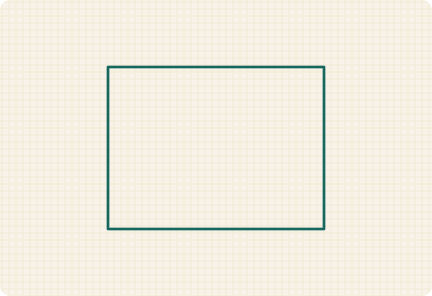
Step 1 of 3
Outline the opening
Count and mark its four corners. Secure the perimeter with close stitches before cutting any ground thread.
Make an open square in a test piece while keeping the remaining threads anchored.
Work the steps ↓ Browse 17 techniques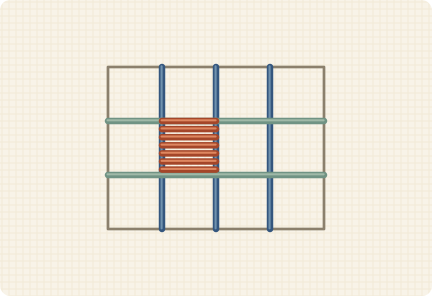
Count and mark its four corners. Secure the perimeter with close stitches before cutting any ground thread.
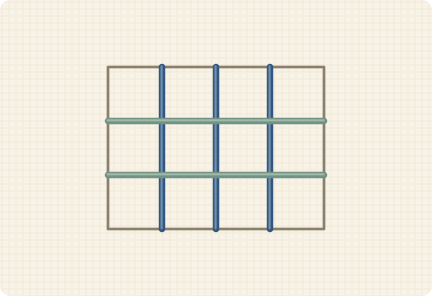
Clip only the counted threads inside the protected area. Withdraw one small group, then confirm the next group to keep.
Wrap the remaining bars and catch the corners at the edges. Add a small darned patch to one cell to test the contrast.
The perimeter stitches hold the cut ends while the wrapped bars tie the grid together.
If you want to carry a latticed-hem or a simple open-work pattern, round a corner, you must cut and loosen the threads, on both sides, about one cm from the edge of the hem.
For cut open-work, threads have to be drawn out both ways, the number of course to depend on the pattern. Threads, left between others that have been cut out, serve as a foundation on which a great variety of stitches can be worked. Stuffs, equally coarse in the warp and woof, should be chosen for all cut open-work, for then the empty spaces that remain, where threads have been drawn out both ways, will be perfectly square.
Remove equal numbers of threads in the warp and the weft directions. For an easily counted trial, remove three and keep three each way. Secure the perimeter before clipping the first thread.
Outline the opening on a scrap of evenweave and secure its boundary first. Follow each thread to both ends with a blunt needle. Lift a single intended thread, check the crossing bars again, then snip inside the boundary and withdraw that thread.
In very fine linen textures, the threads can simply be cut out, but in the case of coarser fabrics, and when a pattern ends in steps, the raw edges must be button-holed, or 99.
Count the number of threads carefully that have to be cut out, run in a thread to mark the pattern, and then only, cut the threads through, at least two threads within the line.
If you only have a small surface to embroider, you can draw out all the threads at once. But in the case of a large piece of work it is better to begin by removing the threads in one direction only, and completing all the little bars, one way first; after which you draw out the threads the other way and embroider those you leave. In this way you will secure greater equality and finish in your work.
Finish the first row of bars along the edge completely, to begin with. In the second row, overcast the bar, down to half its length, then carry your thread over two empty spaces, see the letter a, come back to the bar, overcasting the thread which you threw across first, and passing the needle under the bars of the fabric. In the second rows that intersect the first, marked by letter b, the threads meet in the middle of the empty space.
The little bars which intersect each square crossways, are made in two divisions, by carrying the thread to the opposite bar and back. In the same way, the second thread is carried over the first.
The ground of this part of the square is adorned with narrow bars, worked in darning stitch. From the centre of one bar, proceed three bars made on three foundation-threads, and a fourth made on two, on account of the passage to the next bar.
Mark the center and both axes of a square on counted paper. Plan one quarter of an open lattice and reflect it into the other three. Sample one corner with a solid Gobelin band next to the open work before setting the final border widths.
Lay the first design thread through a row of open cells. Turn at a supported crossing and run a parallel return. Compare the shape with the plan before adding a denser woven filling.
As it is difficult, especially in executing minute, and delicate figures, to withdraw the threads partially, without injuring the linen foundation, they are withdrawn throughout, and new ones drawn in, to form the pattern.
Prepare a small openwork insertion and secure its edges. Outline a simple repeating motif in a thread slightly lighter than the lattice. View it against the fabric it will be mounted on before choosing how densely to fill the repeat.
When it is used to connect bands of cross-stitch embroidery, the open-work should be of the same colour as the embroidery, and the pattern worked in white or unbleached cotton, to correspond with the foundation.
Magnified representation of the work in process of execution, shows alternately, ten threads withdrawn each way and six left, with open spaces between. The arcs are worked over three carefully laid threads, carried across from the middle of one bar to the middle of the bar at right angles to it, the wheels on the other hand are begun and finished at the same corner. Overcast the cut edges, and hem-stitch the outside layer of stuff.
Mark a practice grid with four intact threads between neighboring open areas. Secure the boundaries before removing the selected threads. Darn a supporting bar, then hemstitch the cut edges on both sides. Check its width against the neighboring opening.


