

Step 1 of 3
Place the initial
Draw a simple initial with generous openings. Leave enough room outside it for a narrow border.
Keep a letter readable while fitting raised strokes, open spaces and a border into the same small design.
Work the steps ↓ Browse 17 techniques
Draw a simple initial with generous openings. Leave enough room outside it for a narrow border.
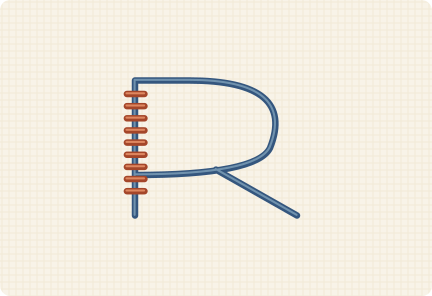
Outline the thin strokes. Add padding and satin stitches only to the wider parts so the openings stay clear.
Repeat one leaf or scallop outside the letter. Count the gap from the letter at corners as well as along the straight edge.
Padding or border stitches have filled the negative spaces. Widen the counters at the drawing stage.
Scallops, worked in very high relief, called Venetian embroidery, are an imitation on stuff of Venetian lace.
Real Venetian point is entirely needle-made; in the embroidered imitations of it, the fabric takes the place of the needle-made lace foundation. The button-hole bars may be made with or without picots. The stuff underneath the bars should only be cut away when the embroidery is quite finished.
Outline the motif and establish the connecting bars while the ground fabric is intact. Cover the bars and secure the outlines before trimming away the fabric between them.
Mark which areas will be open. Span each one with a supported bar wherever its edge needs a connection. Buttonhole the outlines and bars, then cut a small practice opening to check their stability.
This kind of embroidery, which consists chiefly of eyelet holes, and is distinguished for the excellence of its workmanship used to be known as English, but is now generally called Madeira work, from the island where it originated. In working eyelet holes, the material must always be turned in, up to the inside line, and completely worked in, underneath the in order that no loose threads may be visible on the wrong side.
Letters, monograms, coronets and the like, require extreme care in the working, and can only be really well done in a frame. It consists of two wooden hoops, fitting loosely into each other; the inner one, fastened to a support with a wooden screw let into the lower part of it, with which to fasten the frame to the table.
Tambour frames can only be used for embroidering pocket-handkerchiefs and other small articles; all larger work has to be done in an ordinary frame. Sew a piece of strong stuff into the frame, stretch it as tightly and evenly as possible, and cut out a square in the middle to the size of the pattern. Then tack your work in underneath, straight to the thread, dividing it out carefully with pins first, to ensure its being set in perfectly evenly. Roll or fold up the rest of the fabric over the edges of the frame, and secure it with a few stitches or pins, to keep it out of the way of your hand as you work.
Place a capital on a baseline and mark its tallest point. Widen the strokes meant for padded sewing and leave enough open space inside the letter for the shape to stay readable.
Trace both letters at the finished size on paper and mark which stroke crosses first. Work the main stems before adding small ornaments. Leave the enclosed space in the D and the triangle of the A open enough to read at arm’s length.
The flat satin stitch in both letters is worked in white; the setting, is in red, in short stem stitch, or if preferred, in knotted back stitch.
Draw the C first and place the R so its leg stays clear of the curve. At each overlap interrupt one outline on paper before deciding which stroke to pad.
Use a common baseline and keep the opening in the G visible. Test the horizontal bars of the E at full stitched width before transferring the overlapping letters.
Gobelin embroidery is merely raised satin stitch, worked directly upon the pattern, without any foundation, or padding. It can be worked on the article itself, or on stripes, laid on afterwards, with a hem-stitch bordering.
Should a different selection of colours be made, it is important to remember that in all cases a sharp contrast is desirable.
Trace the letters and stitch the surrounding ground in short parallel stitches. Follow the outer contour carefully and leave the letter shapes empty so the uncovered cloth forms the lettering.
Outline a simple shape with stem stitch. Fill around it with short Gobelin stitches in a contrasting value and keep the inner shape clear. Test how sharply the edge reads from a distance.
When these rows are worked upon a satine or cambric foundation, it is advisable to begin by making a small drawing, in which the height of the stitches and the distance between them is accurately marked out, then prick the pattern through and pounce it upon the material beneath.
When they are worked on a material, the threads of which can be counted no such precaution is necessary.
Work small flower heads with short filling stitches in alternating light and dark values. Connect them with a fine stem line and keep the spacing even along the insertion.
One great advantage, moreover, which stripes of this kind, have over larger pieces of embroidery is that they require neither frame nor pillow, nor wearisome counting of stitches, but can be worked in the hand, at all times and places.

From $30.00

From $40.00

From $55.00

From $60.00

From $15.00

From $40.00