
Step 1 of 3
Knot the first row
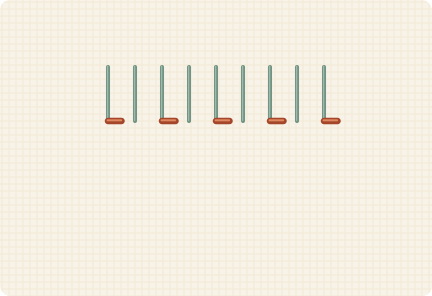
Divide the hanging ends into groups of four and tie a flat knot in each group at the same height.
Keep a net of alternating knots regular, then carry its spacing into a fringe.
Work the steps ↓ Browse 23 techniques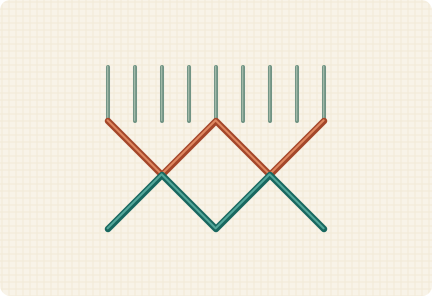
Divide the hanging ends into groups of four and tie a flat knot in each group at the same height.
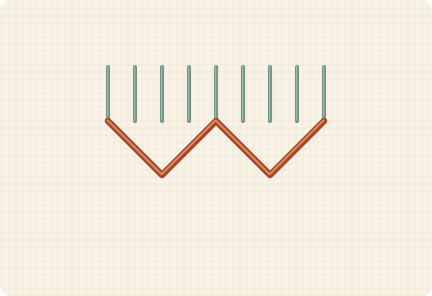
Leave two ends free at each edge. Combine two ends from each neighboring group and tie the next row around the gauge.
Return to the original grouping on the third row. Secure ends before trimming them against a straight guide.
Measure the vertical distance from row to row while the panel hangs under its own weight.
When the quadruple bar, slanting from left to right, is finished, make a similar one, from right to left, then connect the 1st and 16th thread by a double knot and pass the first blue thread on the left over to the right group.
3rd and 5th row—like the first.
Lastly, unite all the threads of one group of bars, and make them into a handsome tassel by the addition of other threads.
Pin the top row to a measured line and mark the center of the fringe. Place the next knot groups between the first groups. Stop after two rows to compare the distance to the lower edge.
The colours alternate in the knots; in the 2nd and 4th row the knot is set in the light colour, in the 3rd and 5th, in the dark.
Fill the shuttles with the length of thread that you think will be required for the work.
The threads that issue from the last group of knots are used for making the second shell bar, the two inner bars of which are made in écru cotton, and the two outer in blue.
Then, over the 2nd thread, which has now become the 1st, make double knots with the 3rd, 1st, 4th and 5th thread; then, over the 3rd thread, counting now from right to left, which in the knotting on figured as the 4th: 1 double knot with the 5th and 2nd thread.
Make the same group from right to left, only at the 3rd change of thread make 5 double knots instead of 2, and let the last knots count for the new group of bars, turned the opposite way.
In the middle of two opposing groups of bars, make a flat double knot with 2 of the right threads and 2 of the left.
When the second horizontal bar is finished, turn the work round, and go on working on the wrong side, making plain double knots, turned in one row, all from right to left, and in the next, from left to right.
When you have worked 10 such rows of knots, begin to make one knot less on either side of a group, so as to form pointed scallops of knots which you finish off with a plain bar.
Knot on double threads, to count as single in the working directions = * 1 thread of red, colour 358, 3 of écru, 1 of red, colour 358, 1 of red, colour 321, 3 of écru, 1 of red, colour 321, and repeat from *.
Then take the red threads on the right and left and twist them, each cluster separately, from left to right between the thumb and forefinger, as you do in making a cord, then unite them together, twisting them from left to right. Fasten off the cord by a knot, beneath which the ends of thread form a little tassel. Collect all the écru threads together and make them into a heavy tassel with the aid of supplementary threads.
Fill the macramé shuttles with the requisite length of thread. Knot the threads on, in the following order; 1 double thread of colour 471, 6 double threads of colour 450, 2 of colour 471, 6 of colour 450, 1 of colour 471.
From left to right and over the 1st thread: 1 double knot with the 2nd thread; over the 4th thread of colour 450, and from right to left, double knots with the 3rd, 2nd and 1st thread of the same colour = from left to right: 1 double knot with the 6th thread of colour 450 over the 5th, and with the 3rd thread over the 2nd = from right to left: 5 double knots over the 8th thread of colour 450 = from left to right: 1 double knot over the 10th thread, 1 double knot over the 5th thread, 1 double knot over the 1st thread = from right to left: 7 double knots over the 12th thread = from left to right: 3 detached double knots.
On the sides, make double bars and between each bar, 2 single chain knots.
To join two borders of the kind together, pass the thread of the second border over the thread on which the bar in the middle of the outer scallop is knotted.
The tassels that complete the fringe must depend from the last collecting knot and hang between the triple bars of knots and beneath the collecting knot.
With the écru threads: 3 flat double knots, 1 double horizontal bar of knots = over the last écru thread: 3 waved knots with 12 changes of the threads = 1 more double bar of knots = join the cord to the outside thread of the blue triple bar.
The light thread is afterwards looped into the blue thread on the right = 4 collecting knots over 6 red threads on the right and left, 1 collecting knot over all the red threads and one, on both sides, over 6 red threads.
After joining the threads on both sides, carry on the single chain with 3 changes of the threads = over the first red thread of the left chain, make 1 double horizontal bar with all the disengaged threads = below the bar, 4 flat double knots = 1 single horizontal bar = 8 double knots, each over a single thread = 1 double bar of knots.
When this pattern is to be used for an insertion or a gimp, the threads should be fastened off.
Wind the threads on shuttles and knot them on, in the following order: 2 threads of, either colour 334 or Chiné d'or (blue and gold), 2 of colour 330, 2 of colour 392, 1 of colour 432, 1 of colour 310, 2 of colour 430, 1 of colour 310, 1 of colour 432, 2 of colour 392, 2 of colour 330, 2 of colour 334, or of Chiné d'or blue and gold.
Over the 3 next, dark green threads, knot the 4 light green threads and the 4 blue, from right to left, and from left to right, thus forming altogether 8 bars across the first bar = then knot the 8 first threads over the last dark green one = add a crossed bar with 7 changes of the threads outwards and 5 inwards.
Middle group, left side: 1 double knot with the first light brown thread over the second thread; 3 double knots with the black threads (the only ones that are to be taken double) and 2 light brown threads over the 1st and 2nd dark brown ones.
In the 2nd bar, knot the 1st dark brown thread, and in the 3rd, the 4 dark brown ones, over the black thread.
On the left—over the 1st light brown thread coming from the right, 1 double knot, made with 2 light and 2 dark brown threads, and the black one, all coming from the left.
On the right—over the 1st light brown thread coming from the left, 1 double knot with 1 light and 2 dark brown threads and the black one (used double).
On the left—over the light brown thread coming from the right, 1 double knot with one light and 2 dark brown threads and the black one.
On the right—over the light brown thread, 1 double knot with 2 dark brown threads and the black one.
On the left—the same knots as on the right.
On the right—over the 1 dark brown thread 1 knot with 1 brown thread and the black one.
On the left—the same knots as on the right.
On the right—over the 1st dark brown thread, 1 knot with a brown thread and the black one.
On the left—the same knots over the last thread.
On the right—over the last brown thread one knot with the black one.
On the left—over the 4 light green threads and the 4 blue ones, double knots with the 4 brown threads and the black one = 1 double knot with the 1st light brown thread over the 2nd, 3 double knots over the 2nd dark brown thread, with 2 light threads and 1 dark brown = 4 double knots with the 2 light and the 2 dark brown threads over the black one; after which you make 5 other bars, taking the last thread turned inwards for the cord. Make similar groups, slanting from right to left, then, beginning again on the left, make the knots with the 4 light green threads over the 1st thread of the same colour running from right to left.
On the right—knot 3 light green threads over the 1st thread coming from the left and repeat the same group twice, on both sides.
The third bar forms, at the same time, the first scallop of a triple crossed bar, which has also to be made on the right.
The two crossed bars finish with a triple group of bars; the last bar of which, on the right, consists of only one double knot.
There remain to be made, on both sides, crossed bars with three whole scallops inside, one outside, and one half one, top and bottom.
Knot all the other threads over the 4 blue and the 4 light green ones = in the middle, knot the right and the left threads, alternately, till the black threads meet at the point.
Turn the group of bars, edged with blue and light green, inwards, and finish it off by a crossed bar, with 3 scallops inside.
Draw the lower curve on paper and set it under the pinned sample. Reserve space for a light open motif. Bring a darker knot line down each side to meet beneath it, easing the knots so they follow the scallop without flattening the opening.
Place four shades of one color in order across a support. Mount an equal number of ends for each shade. Knot the same short repeat across all four groups and comb the ends straight so the effect of the color sequence is clear.
Use the same group of cords in a short hanging sample. After the first row, divide neighboring groups and rejoin them in the next. A repeated offset gives an open ground, while stopping leaves a fringe.
Wind the threads on shuttles and do the knotting on, followed by a double horizontal bar.
Leave a small space between the double bar and the 3rd bar, which is a single one, in which you cross the threads without knotting them.
Beginning on the left—over the 2nd and 3rd thread: 2 buttonhole knots, 1 picot, 2 button hole knots = over the 1st, 2nd and 3rd thread: 1 double knot with each of the 3 next threads = over the 6th and 7th with the 5th thread: 4 buttonhole knots with 1 picot after the 2nd knot.
With each of the 4 next threads, that is the 8th, 9th, 10th and 11th: 1 flat double knot followed by: 1 bar of double knots over the 12th thread as the cord, made with the 11th, 10th and 9th thread = add 1 bar with the 11th thread as the cord, and the 7 next ones as the knotting threads = add 1 bar with the 10th thread as the cord, and the 7 next ones as the knotting threads. Leave 3 threads free on the right = with the 8 threads on the left: 1 bar over the thread before these 3 threads = leave 3 free again on the right = 1 quintuple bar with the remaining threads.
* 1 flat double knot with the 15th, 16th and 17th thread = with the 20th thread, over the 19th, 18th and 17th thread: 4 buttonhole knots with 1 picot after 2 knots = knot 4 threads over the 13th thread and from left to right = from left to right, 2 bars with all the threads **.
Over the 2 threads on the left and with the 3rd thread: 4 buttonhole knots and 1 picot = with the 6 threads from the left: 2 bars consisting of buttonhole knots and picots = a 3rd bar with 6 double knots = join it to the last bar.
Leave 2 threads of the bar of buttonhole knots free = with the outer thread make: 4 buttonhole knots and 1 picot over the 2nd thread and the cord of the bar.
Left group—knot the 3 last threads over the 4th thread and from left to right.
Right group—make, from right to left, 1 bar consisting of 6 double knots, over the 4th thread counting from right to left.
To supply their place, knot on two threads of red Coton à broder under the white threads.
With the red threads (4 count as one) make 3 rows of collecting knots, followed by a single horizontal bar. Divide the white threads into twos and make single chains with them, the whole length of the fringe; the thread must be changed 8 times for each chain; then pass the right chain under the left one and join them by a flat double knot.
You then, with the threads turned outwards, right and left, make the single chain with 5 changes of the threads and join them together again by a flat knot.
The other single chains are made with 6 and 8 changes of the threads and crossed under the double knots. The tassels, which the red threads serve as a foundation to, are begun by: 1 waved plait with two knots, then 4 single chains, again a waved plait and 1 berry composed of knots.
This berry is made over the 8 threads that come from the chains, with a long auxiliary thread, knotted.
Arrange three green threads, six gold and three green across a practice support. Mark the center of the gold group. Work a short mirrored band and record where each color changes from worker to carrier before extending the repeat.
Knot on 4 threads for every group of knots, and secure them by a knot and a picot. Work the groups of knots, and after each group is finished, thread a gold bead on to every 2 threads.
For every square, you count either one single or one double thread, according to the scale on which the work is to be.
In the case of a single thread, you count one double knot per square, in that of a double one, 4 double knots, two in the first and two in the second row.
After knotting the threads together, two and two, and pinning them to the cushion, see letter a, make 2 single chains with 2 changes of the thread, letters b and c, then take a very long cord, letter d, and knot on the threads. The cord forms picots along two sides of the square; into which you fasten threads, letters e and f, for the single chain formed, on the two other sides by the knotting threads.
The coloured threads for the flowers are knotted on as the pattern requires it, taking the place for the time being, of those with which the foundation is made, which are left hanging on the wrong side until they are wanted again.
The top leaves of the iris shaped flower, are worked in two shades of blue; the bottom ones, in three shades of red, the stalk and the leaves in green, and the little stars, with which the ground is powdered, in real gold thread.
The little tassels between the knots, are made separately from the rest of the work and fastened on by the thread with which you sew them together at the top.
Mark a small diamond on squared paper. Choose a pale carrier cord for the ground and a contrasting working cord for the diamond. Follow the working ends across one repeat before extending it.
Begin with the light red thread and make: 1 single chain with 3 changes of the threads, 1 single chain with the dark red thread with 4 changes of the threads.
When all the red threads are knotted over the white ones, make crossed bars with the red threads by themselves, thus producing a point at the bottom of the leaf.
Then, over the first white thread coming from the right, knot all the white threads on the left of it and in the last place, the cord itself, over the 3 red threads.
Make the same series of threads on the left. This is succeeded by a second bar of white knots, the last thread of which is left unknotted. Make 4 double knots with the 8 white threads and close the square by a double bar. Add a supplementary thread to the first bar, so that you may have 10 threads coming from each side of the second bar and over these you knot the red threads, which form a dark setting to the leaves.
When this is done on both sides, make 10 flat double knots with a supplementary knot, taking 4 single threads for each knot, and decreasing the number of knots successively to 2. At the point of the inside square, knot the white threads over the red ones and turn back the second white thread to serve as a cord to the first of the outside bars. Join the first thread on the left and the first on the right, to form a flat knot with them in the middle, the threads of which are then passed over the red threads; the last white threads become the cords for the second outer bar. Make a group of bars with the red threads and cross them 3 times, then finish with a handsome tassel and join the white threads together all round the square with tassels.
Macramé fringes are not capable of being drawn up, as knitted, crochet, and netted fringes are, on the inside, so as to turn the corners. Consequently, according to the pattern, a greater or less number of supplementary threads have to be knotted in so as to form the corners.
On the two middle threads, which are a continuation of the connecting knot, 7 supplementary threads have next to be knotted, thread 7 singly, threads 8 and 9 together, threads 10, 11, 12 and 13, all singly.
The bars, formed by the knots which are made with the supplementary threads, must be drawn tight, like any other double bar.
A long, coloured thread is looped on to the topmost thread, between the two bars, and with this, knots are made over all the 14 threads that come from the bars and run inwards.
In the middle of the square there must be 9 flat double knots; when these are made, you continue knotting the red thread from the right and left, down to the bottom point of the square, and complete the figure by a single bar of knots, made of the white thread.
Knotted tassels, hanging from the points of the scallops, and others ornamented with flat double knots made of 10 threads, suspended between the scallops, form the outside finish to this fringe.
Over 2 cords on the left and 2 on the right, consequently over 4 threads: 5 buttonhole knots, with the 4 threads and the disengaged threads, 1 flat double knot over each of the 4 threads. This forms a shell knot, on either side of which, make 3 buttonhole knots over 3 threads.
For the groups of bars on either side of the shell, take the 11th, 12th, 13th and 14th double thread on the left, and the 3rd, 4th, 5th and 6th on the right. These groups are joined by buttonhole knots.
Knot the 4 threads of the left group over the cord on the right; and over them again the 2 next threads on the right; knot the 4 threads on the left over the 4th thread on the right; make 2 buttonhole knots with the 4th thread over the 3 threads at the bottom and on the side.
Over the 4 threads, that come from the left and right, make quadruple bars; cross the upper threads after the second row of bars, make 2 buttonhole bars with the next thread over the 4th thread, then finish the 3rd and 4th bar of knots.
To make the olive-shaped group of knots on both sides, take the threads, that come out from the shells, as cords.
The 4th group of bars which forms the corner of the fringe, is made on the 4 threads that come from the large shell, on to which the fourth set of 12 supplementary threads is knotted.
All the threads that come from the groups are then collected at the top of the scallops and overcast with strong thread, so as to form a thick round cord along the edges of the scallops, widening towards the point, as more and more threads are taken in.
Collect the 21 threads all together, to begin with; then make: 2 rows of knots over 12 threads, 1 over 15, 3 over 21, 1 over 15 and 2 over 12; then cut the ends of the 21 threads to the same length, and turn them inwards, to fill up the hollow space inside the berry, stuffing it besides, if necessary, with wadding to make it perfectly firm and hard and sewing it together at the ends.
Into the loop formed by the 4th thread, you hang 3 small ring knots, made of a single chain, with a loop, top and bottom, formed of the ends of the thread.


