
Step 1 of 3
Make a foundation
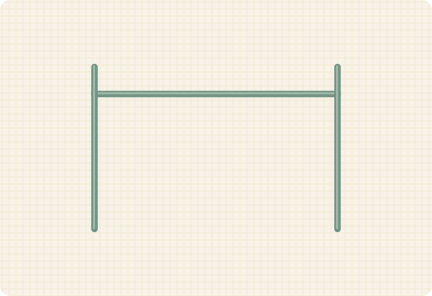
Anchor the thread and stretch a level line from edge to edge inside the opening.
Control the height and grouping of buttonhole loops across a bounded opening.
Work the steps ↓ Browse 25 techniques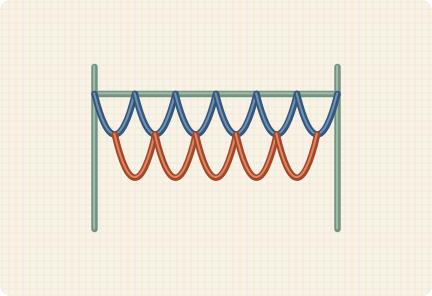
Anchor the thread and stretch a level line from edge to edge inside the opening.
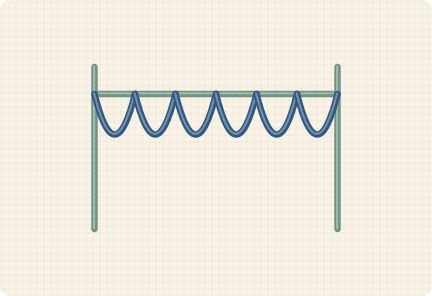
Make evenly spaced buttonhole loops around the foundation. Catch the far braid without shortening the row.
Return across the space, working into the loops of the previous row. Try two stitches in one loop and skip the next to create groups.
The first and last loops differ in depth. Mark the intended row height on both braid edges.
Instead of passing the needle behind the thread, pass it before it and round it, so that the needle always comes out again beneath the thread, which will then be twice twisted.
Work between two facing edges. Form the lower connection as a plain crossed bar, then take the second thread three times around the first near the upper connection before moving along.
Make very loose buttonhole stitches along both edges of the braid, all the same size and the same distance apart, and vertically, opposite to each other.
Join two opposite rows of loops with four side-by-side stitches. Keep them flat and separate. Wrap the lower loop after the fourth stitch and carry the thread to the next group.
Over the middle of two finished plain bars and one half-finished one, a short distance apart, you make five buttonhole stitches and overcast the remainder of the third bar.
Represents a similar beginning, and a similar interlacing of the threads, but ornamented this time with a wheel, added after the knot has been made over the loops.
Lay five foundation strands across a small leaf outline and fasten them at each end. At the tip, group two against three for the first darning passes. Alter the width of the passes as the leaf widens, keeping the central axis straight.
Here, you have to make two rows of Russian stitches opposite each other and carry the thread to the point of intersection, then, you make a wheel over five threads and pass the needle under the completed wheel to reach the next point of intersection. Half wheels may also be added at the edge of the braid.
Carry the thread horizontally across the middle of the space intended for the insertion, to the opposite side, and then conduct it by means of overcasting stitches into the corner; thence make a loose loop over to the opposite corner, pass the needle under six or eight threads of the braid edge, slip it under the horizontal thread first laid and behind the loop, and finish the stitch on the other side in the edge of the braid.
Throw the thread again across the empty space and over the first thread, bring your needle back to the middle, make a big wheel over four threads, passing each time under the same threads, then overcast the single thread, come back to the edge of the braid and make the second loop, bringing out the thread at the same place where the other stitches came out.
Over plain but very distended Russian stitch, make darning stitches backwards and forwards, beginning at the point and reaching to the middle, so as to form small cone-shaped figures.
To reach the point of the next cone you overcast the thread of the Russian stitch several times.
You may also, double the Russian stitch and make the darning stitches in such a manner that the points of the cones touch each other and their bases meet the edge of the braid. The same thing, worked the reverse way, that is, with the points turned outwards to the edge, produces a not less pretty effect.
After making rows of loose buttonhole stitches along the braid edges, run a thread through the buttonhole stitches; this thread serves as the foundation to the Russian stitches by which the two edges are joined together.
Fasten on the thread in one of the corners of the braid and conduct it by means of overcasting stitches to the middle of the insertion, draw it through the edge of the braid on the right and make buttonhole stitches over it, to the middle of the space to be filled, then carry the thread to the left, draw it through the left edge, a little higher up than on the other side, and make the same number of stitches over it as over the first.
Make rows of buttonhole stitches back and forth, loose enough to form loops into which the stitches of each subsequent row are set. You must be careful to make the same number of stitches in all the spaces that are of the same size, and also, when you begin a row with a whole stitch, to begin the return row with a half, and so on, in regular rotation.
The loops must be as many threads of the braid edge long, as they are wide.
Work a foundation row of even loops between two edges. Into each loop of the next row work two closely spaced buttonhole stitches. Keep the span between pairs shallow and even so the paired catches form a distinct open ground.
Here, you make three buttonhole stitches close together, joined to the next three by a loop of thread, just long enough to hold the three buttonhole stitches of the subsequent row.
Working from left to right, make two buttonhole stitches rather near together, and leave twice as long a loop between them and the next two stitches as between the two first.
In the next row, which is worked from right to left, make one stitch in the loop between the two stitches that are close together and three or four in the long loop.
, you begin this stitch from left to right, but making three stitches very close together with an intermediate loop as long as the three stitches in one.
In the second row, you make one buttonhole stitch in each of the loops between the three stitches and six or eight in the long intermediate loop.
Over wide loops, made from left to right in the first row, make in the second, enough buttonhole stitches entirely to cover the thread.
In the third row of stitches, put the needle into the small loop between two sets of buttonhole stitches, so that the close stitches shall form vertical lines across the surface they cover.
Begin, working from right to left, by making one row of pairs of buttonhole stitches, a very short distance apart; in the second row you make one buttonhole stitch between each of these pairs, and in the third row, two buttonhole stitches in every long loop.
This stitch is generally known as the "pea-stitch" on account of the holes occasioned by the different distribution of the stitches.
The first row consists of stitches, set rather closely together, and all the same distance apart. In the second row, you make one buttonhole stitch in the last stitch of the first row, then, missing two loops and three buttonhole stitches, you make two stitches in the next loops and so on. In the third row, you make three stitches in the big loop, and one in the loop between the stitches of the second row.
Both, the small and the big pointed groups of stitches, begin with a row of close buttonhole stitches.
Requires three rows; in the second you miss two stitches and make two in the next loops; in the third, only one stitch is introduced between the two loops of the lower row.
The stitches of the first must be set as closely together as possible; in the second row you make four stitches and miss two of the first row, in the third row you make three stitches, in the fourth, two and in the fifth, one only. The long loops of the last row must not be too slack so that the first stitches of the next scallop may quite cover them.
The first row consists of plain net stitches; in the second, you have three buttonhole stitches in the middle net stitch; in the third, three buttonhole stitches in the whole loops on either side of the three buttonhole stitches of the second row, and one stitch in the half loops that precede and immediately follow them; the fourth row is similar to the second.
In the fifth row the close stitches are changed. The three buttonhole stitches are made in the third whole loop, before and after those of the fourth row, so that between two groups of three stitches you have six single buttonhole stitches and seven loops.
Fasten on your thread, take it by overcasting stitches over the braid edge, half a cm from the corner, and make three buttonhole stitches downwards, quite close together. The next loops, over four or six threads of the braid, must be left long enough to be on a level with the first stitch reaching downwards from the edge.
In the second row, you cover the long loops with three buttonhole stitches and draw the intervening thread quite tight.
The third row is like the first, with the difference, that you put the needle in between the two threads of the buttonhole stitch, instead of through the loops.
The stitch here represented, as well as the two next ones are looped from left to right and then again from right to left.
Requires, in the first place, two buttonhole stitches very close together in the edge of the braid, then a third stitch covering the two first stitches and set quite close to them; the connecting thread between these stitches must be tightly stretched so as to lie almost vertically, that the stitches may form straight lines.
On an even foundation work a pair of buttonhole stitches, leave a space and repeat. Set the next row’s pairs above the pairs below. After three rows, inspect the upright supports and ease any span that pulls them sideways.


