
Step 1 of 3
Mark the pile line
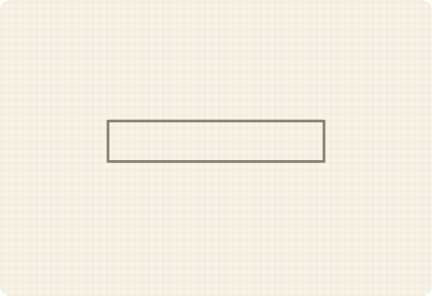
Draw two parallel lines for the ends of a short pile sample. Lay the gauge along the first line.
Use a smooth gauge to build a row of loops of equal height and secure each before moving on.
Work the steps ↓ Browse 8 techniques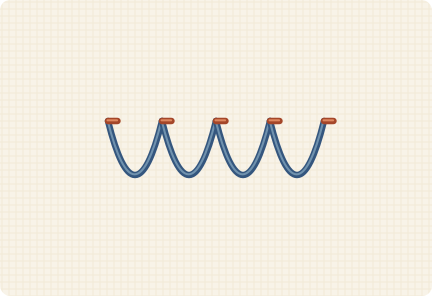
An edge, cord, loop or piece of applied cloth changes both the outline and the feel of an object. Test the join at its finished thickness, especially where applied work must bend around a corner.
Draw two parallel lines for the ends of a short pile sample. Lay the gauge along the first line.
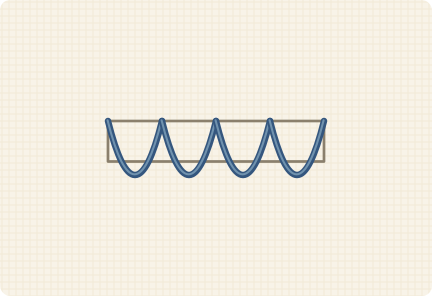
Bring the thread up, carry it over the gauge and back down through the ground. Anchor each loop at its base before making the next.
Slide the gauge out along its length. Inspect the anchors from the back and gently lift each loop with a blunt needle.
The next stitch pulled on an unsecured base. Anchor each loop independently.
It is by thus drawing up first a loop on the right and then one on the left that this pretty cord is produced.
Skilful hands will soon learn to make a cord of the same kind with four threads, as follows: knot the four ends of thread together, make a few knots, using two threads as one, then dropping the loop on your forefinger, put the next one upon it and draw up the knot, passing however the threads over those that you dropped. Then drop the loop you have on your finger again and take up the first loops.
If you have a great many balls to make it is well worth your while providing yourself with a metal die of the proper size, to cut the rounds with.
As however, the fine patterns with a good deal of shading in them, can be far more accurately worked by hand than by machine, tambouring, which is in point of fact merely a form of crochet, has lately been revived. The piece of stuff on which the tambour work is to be done must be mounted on a frame.
From the thimble being cut slightly slanting at the top, it follows that the inside where the two ends meet is a little shorter than the outside.
The thread is drawn through in a loop to the front of the work by means of the hook, while it is held at the back in the left hand, and when the needle is put downwards through the fabric, laid round it.
As soon as you realize that the upward drawing of the needle and the downward pressure of the fabric with the thimble must be simultaneous, you will find that you can work with great rapidity and with admirable results. Thread with a very strong twist, which the hook will not split, is the only suitable kind for tambouring.
Smyrna stitch requires only a crochet needle and is worked on very coarse canvas or Java linen. As you finish each row, comb the ends of the tassels out carefully with a fine metal comb. When the whole piece of work is finished shear the entire surface, quite even, with a pair of sharp scissors.
The needle must now follow the same course it took for the first stitch and the thread must be drawn out far enough to form a loop as long as the tassel; you then repeat the second stitch, carrying back the working thread however this time above the loop, after which you cut the two open ends the same length as the loop. In the Maltese work, three times as many threads have to be left between the tassels as are covered by the stitch.
Thus if your stitch cover 4 threads of the foundation, you should leave 12 threads between the tassels, and if it cover 6, you should leave an interval of 18 threads, that the fabric may always be visible between the little tassels or balls.
Malta embroidery is mostly done on coarse coloured linen fabrics or on single thread canvas.
Amongst the many pretty stitches for which Turkish embroideries are distinguished, there is one in particular, which though apparently very difficult, is in reality quite the reverse; it resembles line stitch upon straight threads, only that in the East it is generally worked in diagonal lines, each row requiring two journeys back and forth.
Coming back, you pass the needle under the fabric and the stitch on the right side, and bring it out at the bottom of the stitch; then you make a back stitch over two horizontal and two vertical threads, pass the needle over two straight threads, put it in behind the same, bring it out again near the upper stitch and then insert it near the bottom vertical stitch; after this you carry it to the second stitch lower down and pass it over the same. Four threads should meet in every hole which the needle makes.
Show how the same stitch can be worked in straight, instead of in diagonal rows.
The diagonal lines are all worked with Chiné gold and blue, and gold and red.
The running foundation is divided into slanting squares; the diagonal lines are all worked in gold and red. The squares number 9 stitches inside, these are followed by a tenth which is covered by the first stitch of the next square. Where two kinds of coloured gold thread are used, one square will be framed on all sides by one kind, say, gold and blue for instance, the next by the other, gold and red.
The stalk that divides the two little leaves and has a small lozenge at the top, is begun above the fifth of the 9 stitches; you make 5 stitches, but in such a manner as to end at the top of these 5 with the stitch that runs in a diagonal direction over the threads, turned to the inside of the stalk, so that the last stitch of the first row may form with the first stitch of the second row, a triangle at the top of the stalk, which is surmounted by the aforesaid lozenge.
The leaves in Chiné gold and green, on either side of the stalk, also begin with a stitch over 3 threads of the fabric, followed by 8, each increasing in length by one thread on the side of the stalk, but all equal on the other, the last extending over 12 threads of the fabric. After these 9, the subsequent 8 must decrease in the same manner by one thread on the opposite side; then you make 4 more extending over only 3 threads and set the contrary way to the others.
The zig-zag border and the small squares of 5 stitches within it are worked entirely in Chiné gold and red.
The petals are set with stem stitch in fine black Coton à broder and if the embroidery is to be the same on both sides this setting must be repeated at the back.

From $50.00

From $15.00

From $40.00

From $15.00

From $55.00

From $15.00