
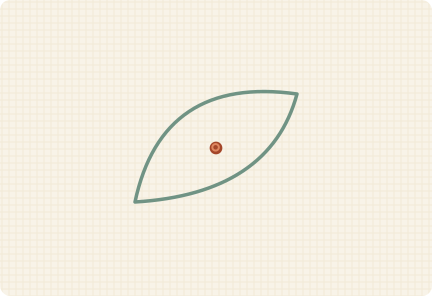
Step 1 of 3
Position a shape
Cut a simple leaf and tack it at the center and tips. On woven appliqué allow fabric for a turned edge.
Use an applied shape, a couched outline and a stitched vein to give one motif three surfaces.
Work the steps ↓ Browse 12 techniques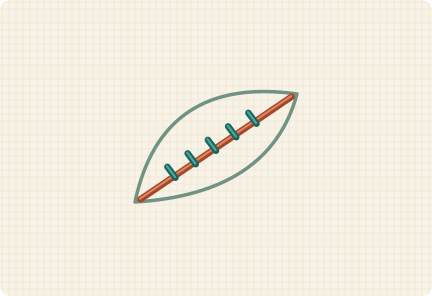
Cut a simple leaf and tack it at the center and tips. On woven appliqué allow fabric for a turned edge.
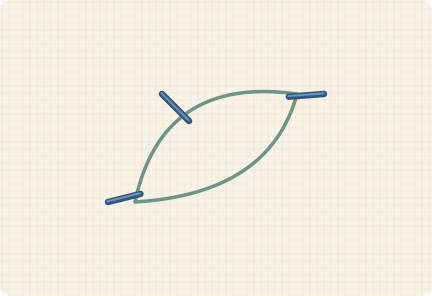
Make small spaced catches around the edge. Adjust the spacing around the tips so the shape stays flat.
Lay a length of cord along the midrib. Catch it at right angles with fine thread, spacing catches closer at the curve.
Bulk or tension collects at the narrow end. Reduce the turned allowance on the trial piece and shorten the spacing.
Attach a contrasting fabric motif to a ground so the cut shape supplies the color.
Count a small repeat on an even ground. Darn one band by carrying the thread over and under the ground in sequence. Set a row of longer counted diagonals beside it. Turn the sample over and compare how the two paths travel.
The buttonhole stitches, for which the more subdued shade of the colours indicated should always be taken, or else yellow, dark or pale, to match the gold thread, are made over two threads of gold and follow the outlines of the pattern, which should be more or less appropriate to this style of embroidery.
Where the picots have to fill up empty spaces of a larger size, you can join several together by connecting them each in turn with the first.
When you have bordered all the outlines with buttonhole stitches and picots, fill up the spaces enclosed within the lines, which properly speaking form the pattern, with flat stitch embroidery, worked in Coton à broder or Coton à repriser; after which the whole surface is sewn over with fine little spangles which give the sparkling look that constitutes the peculiar charm of this kind of embroidery. The flowers are covered with a fancy stitch that forms regular little lozenges, and every second row of stitches is hidden under a spangle.
When all the needlework is finished, you cut away the fabric underneath the network formed by the picots, with a pair of sharp scissors.
Basket stitch can be worked on all kinds of fabrics, on counted threads or on a wide or narrow tracing, with fine or coarse thread, and more or less closely, according to the taste of the worker.
You insert the needle from right, and pass it under, from 3 to 6 threads of the foundation, according to the fabric and the material you are using, then downwards from left to right, and over, from 6 to 8 threads, into the fabric again from right to left; then you push it under the fabric in an upward direction and bring it out on the left in the middle of the space left between the last stitch and the top of the second.
This is a stitch often met with in old church and house linen embroidery. A beautiful design worked in this way is given further on.
Contrary to most stitches, this is worked upwards; the needle is put in horizontally under the fabric, the thread tightly drawn, then laid from left to right and drawn through underneath the first stitch and a tight knot made.
All these ways are admissible but care should be taken in each case, to make the stitches perfectly regular; it is the direction which is given to the stitch and the number of threads taken up with the needle that changes the appearance of the stitch.
Lay a thicker thread along a line, then cover it with stem stitches to lift the outline above the cloth.
The straight lines of this border are all worked in old German knotted stitch in écru thread, forming a thick round cord which stands out from the surface in high relief; the flatter outlining of the outside figures is done in basket stitch in soft blue knitting cotton. The little oblong figures within the two inner lines of the border are worked in Gobelin stitch, in red embroidery cotton, and the filling of the figures, outlined in basket stitch, in one or other of the Irish lace stitches, worked in white lace thread, either so that all the stitches enter the fabric, or form a network over it.
This consists of stitches that are worked in the width of the fabric, intersected by back-stitches set slightly slanting.
The original, still very well preserved, notwithstanding its age, is worked in silk of a brilliant red on a stiff stuff which has been coloured by time and use.
Roumanian stitch is used wherever the lines of the pattern are widest; there where they narrow, in the indentures of the leaves and the twists of the stalks, flat stitch is used instead.
By the repetition of the detached subject, this pattern may be made to serve either for a stripe or for a grounding; if you use it for a stripe, the centre flower of the principal subject with the stalks lengthened, will look very well worked as a separate subject between the large bouquets. Worked in a double row, base to base, on any stuff and in any material, these large figures form a very handsome border which makes an effective trimming for furniture and curtains.
A similar kind of work was common in Bohemia until a recent date for the making of caps.
The pattern is drawn upon the fine stuff, because on that side the different kinds of stitches are made.
Fill up in this manner all the ground of the pattern, leaving the arabesques and the ornaments plain, or embellishing them with some kind of lace or embroidery stitch.
(braid).—This alphabet, which is one of the best of its kind, was taken from a work published in Venice in 1662, by Giovan' Antonio Tagliente, secretary and calligraphist to the Republic.
In order to reverse the position of the flowers thus, you will have to make two tracings of the spray, one negative and one positive.
Nothing could be simpler than the mode of working these flowers.
In order to give a different character to the flowers, use Soutache of different widths, fold it over more or less closely and lay it down in shorter or longer lengths, as required.
The stamens of the marguerites are worked in knot stitch with yellow cotton and those of the cornflowers with dark blue.
Trace a small shape on a countable ground and divide it into three areas. Fill them with different stitch directions at one thread weight. Look for contrast before introducing another color.

From $39.99

$34.99

$34.99

$34.99

From $25.00

From $20.00