
Step 1 of 3
Open a test channel
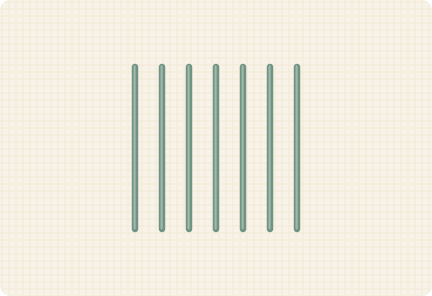
Withdraw a few parallel fabric threads between two marked stops. Keep the perpendicular threads intact.
Open a narrow channel in evenweave linen, then compare straight and staggered bundles.
Work the steps ↓ Browse 17 techniques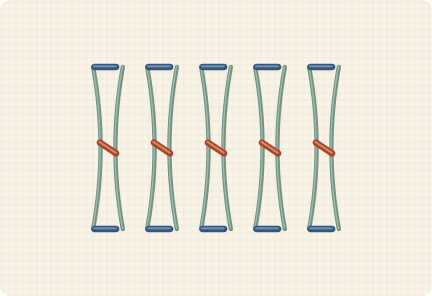
Drawn-thread work begins by withdrawing selected threads from a woven ground. The threads left across the channel can be gathered, wrapped or darned into groups. A spare strip lets you check the count before opening the final cloth.
Withdraw a few parallel fabric threads between two marked stops. Keep the perpendicular threads intact.
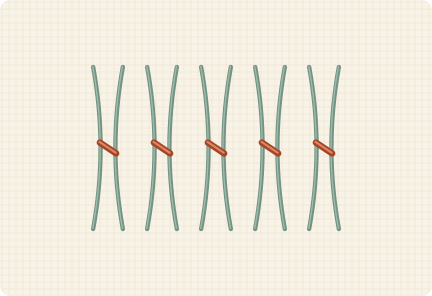
Pass under four exposed threads and secure them at the edge. Count four for each following bundle.
At the opposite edge take half of one bundle and half of its neighbor. Compare the resulting diagonal openings with straight rungs.
Check the number of ground threads in each bundle before changing tension.
Start with evenweave linen whose threads separate cleanly when teased out. Try the working cotton around a small bundle. The binding should hold it together while leaving the open channel visible.
The one is called, single open-work, the Italian Punto tirato, in which the first step is to draw out one layer of threads; the other, cut open-work, the Italian Punto tagliato, for which, both the warp, and the woof threads, have to be drawn out.
This, in its simplest form, is the ornamental latticed hem, in common use where something rather more decorative than an ordinary hem is required, and consists in drawing out one layer of threads, either the warp or the woof.
Gather small bundles of exposed threads while fastening a folded linen hem.
Work from left to right along a prepared hem. Gather two or three threads from right to left. Skip the same number along the folded edge, enter the fold from above and bring the needle out at its base. Repeat with the same count.
Work matching hemstitch rows on opposite sides of a drawn band to create upright bars.
Begin, forming your clusters of an even number of threads; and then, in making your second row of stitches, draw half the threads of one cluster, and half of the next together, thereby making them slant, first one way and then the other.
At the necessary depth for forming a narrow hem, a thread is drawn, in the case of very fine textures where the edge is rolled, not laid; then fasten in the working thread at the left, and work the stitches from left to right. Passing your needle, from right to left, under three or four threads, draw the thread round the cluster and carry your needle on, through as many threads of the upper layer of stuff, as you took up below, so that the stitch may always emerge from the middle of the cluster.
Roll the edge beside a drawn channel. Work from right to left, bringing the needle between neighboring bundles, around the narrow roll and back between bundles. The wrapping thread should show on both faces without flattening the roll.
Bring out your needle and thread, two or three threads above the edge of the turning, between the first and second of the three cross-threads that compose the cluster, and then slip it under the cluster, from right to left. The loop must lie in front of the needle. When you have drawn up the stitch, put the needle in, one thread further on, and take up two threads.
Complete one hemstitched band. Count down by the width of one bundle, open a second channel, and divide neighboring bundles between the two rows to make a staggered seam.
Make six rows of hem-stitching; the first and sixth rows to serve as a finish, above and below.
Divide the threads of the perpendicular clusters in two; insert the needle, from left to right, underneath half the second cluster, turn the needle's eye, by a second movement, from left to right, and take up the second part of the first cluster, drawing it under, and at the same time, in front of the first half of the second cluster. Be careful not to draw your thread too tightly.
Finish both edges of a wide drawn band with matching bundles. Pass a colored thread between alternate bundles. Run a second thread back through the gaps in the opposite sequence. Ease both ends until the band is still its original width.
Secure the upper and lower edges. Draw the bundles together along the middle first. Lace above and below that line, checking the band after each pass so it stays the same width.
Draw out from sixteen to eighteen threads, between two hem-stitched edges. Fasten your thread in, 3 mm above the seam-edge, and wind it three times round every two clusters, passing the needle, the third time, under the two first rounds, to fasten the thread. The thread, thus drawn through, must be left rather slack. A second row of stitches, similar to the first, and at the same distance from the bottom edge, completes this pattern. To give it greater strength, you may if you like, work back over the first thread, with a second, taking care to pass it under the knot, which was formed by the first.
Work two hemstitched edges to bound the insertion. Arrange the exposed strands into groups of three clusters, then repeat the group across the band before drawing up the lacing.
After portioning off, and sewing up the clusters on one side, draw out twelve or fourteen threads, and make your connecting-stitch and hem, all in one, as follows: bring out the thread before the cluster, and pass it round it, then from right to left, over three horizontal and under four perpendicular threads, again from left to right, over the four threads just passed over, and out at the second cluster; laying it over this, you bring it out behind the first cluster, wind it round the middle of them both, and pass it through, between the over-casting stitches back to the hem; encircle the second cluster with a loop-stitch, and carry your thread again over three horizontal and four perpendicular threads, and upwards, slanting underneath the fabric, out in front of the next cluster.


