
Step 1 of 3
Make the foundation
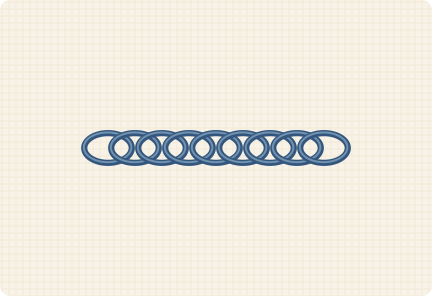
Chain a short strip. Mark the first stitch you will work into so you can find it again on the return row.
Compare stitch height by watching how many loops stay on the hook during each draw-through.
Work the steps ↓ Browse 35 techniques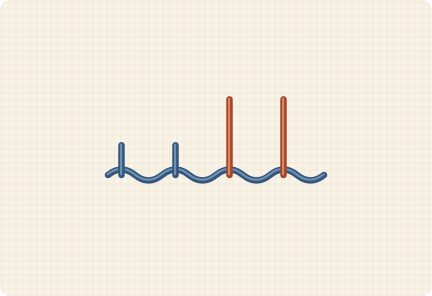
A crochet hook draws successive loops through a chain or an earlier row. Match the hook to the yarn and the opening you need. For Tunisian crochet, leave enough space on the shaft to hold the loops of a whole forward pass.
Chain a short strip. Mark the first stitch you will work into so you can find it again on the return row.
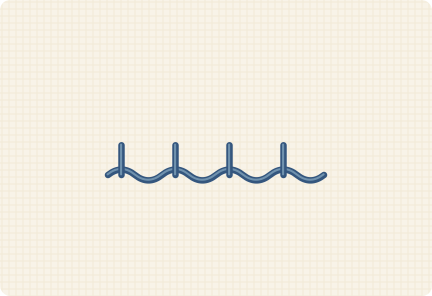
Insert the hook, yarn over and pull up a loop. Yarn over and draw through both loops. Repeat across a small section.
Yarn over before insertion, pull up a loop, then draw through two loops twice. Compare the post with the shorter stitch beside it.
Check whether you wrapped the yarn before inserting the hook. That initial wrap changes the stitch construction.
Mark the beginning and end of the repeated group before picking up the hook. Work the setup once, then count the groups across. Count the edge stitches separately.
In point of fact, there is only one, because all crochet work consists of loops made by means of the hook or needle, and connected together by being drawn the one through the other.
In German crochet there are eight different kinds of stitches: (1) chain stitch, (2) single stitch, (3) plain stitch, (4) treble stitch, (5) knot stitch, (6) bullion stitch, (7) cluster or scale stitch, (8) double stitch.
The rows are worked, according to the kind of stitch, either back and forth, or all from one end.
At the end of each row, cut the thread and draw the end through the last loop; in this manner all crochet work is finished off. Some crochet workers make a few extra chain stitches with the ends of the thread at the beginning and end of each row, or fasten them off with a few stitches on the wrong side.
They can also, when the occasion requires, be formed into a fringe or tassels as a finish to the work.
Draw a series of loops through one another to make a flexible starting edge.
Insert the hook through the indicated loop of the row below, catch the yarn and draw it through the fabric and the loop on the hook in one movement. This historical single stitch works like a slip stitch.
Insert the hook under the top loop, draw up a loop, yarn over and pull through the two loops on the hook. In modern US terms the basic movement is single crochet.
Crochet back and forth in rows, inserting the hook under both strands of the top V of each stitch. Compare the even surface with a back-loop-only row.
Work the plain stitch through both top loops across. Fasten off and join a new strand at the starting side for the next row. Leave tails long enough to secure.
Turn after every row. Work each stitch under the back loop of the top V and leave the front loop free. The unused strands form the horizontal ridges.
Work through the back loop with the same face toward you on each row. Compare the placement of the unused loops with the ridges made by turning after every row.
This stitch also is only worked on one side. Put the needle in under one of the vertical threads of a stitch and complete the plain stitch. This is a stitch that looks very well on the wrong side; the bars of the loop lie quite close together, which makes it particularly suitable for unlined articles of clothing. It requires a large-sized needle to do this stitch well, especially if the material be a heavy one.
Keep the right side toward you. Take up the back strand of the stitch below, draw a loop through without a preliminary wrap, then complete the stitch by drawing the yarn through the two loops.
Use the slanting-stitch movement but take up both strands of the stitch below. Work a short band beside the back-strand version so you can compare how the stitch sits.
To work this stitch which runs in slanting lines, put the needle in between the vertical threads of the stitches and underneath the two horizontal ones.
Counterpanes can be made in a less close stitch than those just described.
To produce a soft and elastic fabric turn the thread round the needle and insert it under both the horizontal threads of a loop, take up the thread without turning it round the needle, draw it through in a loop, make an over, and draw the thread through all the three loops, that you have on the needle.
Make an over, put the needle through the two horizontal threads of the stitch below, make another over and draw it back through the two loops and the first over, make another over, and draw the thread through the last two loops.
Worked as follows: when you have put the needle into the loop of a stitch below, carry the thread, downwards from above, round a stripe of cardboard or a flat wooden ruler, then finish the stitch in the usual way. These long loops, each about 2 cm in length, can also be made over the forefinger and held fast by the thumb as you work, but it is more difficult to make them regular in this way.
Each row of long stitches is followed by a row of plain stitches. If you wish this stitch to be very thick and handsome, wind the thread three times round the ruler, or finger, and secure it with a plain stitch; in this case, you should make one plain stitch between every two clusters.
Begin with two chain stitches, put the needle in between the two threads of the first chain stitch, turn the thread round the needle and draw it through in a loop, turn it round again and draw it through the two loops; then, put the needle into the left part of the stitch that was just made, turn the thread round the needle, draw it through the two loops and so on, to the end.
Trebles are little columns, or bars made of loops or stitches. They can be worked, like all other crochet, either back and forth, or all one way. There are different kinds of trebles; half or short trebles, trebles, double trebles, called also 'long stitch', and quadruple and quintuple trebles, called 'extra long stitch', connected trebles and crossed trebles.
Yarn over, insert the hook and draw up a loop. Yarn over again and pull through all three loops together. This movement is a half double crochet in modern US terms.
Begin, as for the half treble, by turning the thread round the needle, and putting it in under one edge of the stitch beneath, then take up the thread on the needle and bring it through two of the loops, take it up again, and draw it through the two remaining loops.
Turn the thread twice round the needle, put it into a stitch of the work and bring the thread through in a loop, then take up the thread on the needle and bring it through two of the loops, three times in succession.
For a triple treble, twist the cotton three times round the needle, for a quadruple one, four times, then form the treble in the usual way by bringing the needle through two of the loops at a time. To make a series of trebles, of gradually increasing length, bring the needle, at every other treble, through the last three loops, so that before making a triple treble you will have to make columns, respectively, 1 treble, 1½ treble, 2 trebles and 2½ trebles long. Columns like these, of different lengths, are often required in crochet work, for leaves and scalloped edgings.
Trebles, connected together, can be worked back and forth, and take the place of plain stitches. Begin with a chain, then make a treble of the required height, form as many loops as you made overs for the treble, take up the upper thread of the stitch nearest the treble, turn the thread round the needle, bring it back to the right side and draw the needle through the trebles, two at a time.
Trebles of this sort produce an open stitch, which is often used for the footing of lace, or for an insertion. Make a foundation of chain, or other stitches, and proceed as follows: 3 chain, miss 2 stitches of the row beneath, make 1 treble in the third stitch, 5 chain, 1 over, put the needle in between the loops of the connected trebles and finish with a treble. This leaves 3 loops on the needle. Make an over, put the needle into the third stitch of the row beneath, make an over, and bring the needle back to the right side.
Join the 5 loops on the needle together, 2 and 2, make 2 chain, 1 over, put the needle into the upper parts of the connected trebles and finish with a treble, and so on.
Generally speaking you make the trebles over the same number of stitches as you made overs on the needle, which should always be an even number.
Chain four. Yarn over twice, insert into the first chain, yarn over and pull up a loop. Yarn over and pull through two loops three times. For the next post, insert into the lower left part of the completed post and repeat the tall stitch.
This stitch which is composed of several loops forming a tuft, can only be worked from one side, consequently all one way.
Enter the needle through the two loops of the stitches of the bottom row, turn the thread round the needle, but away from you towards the back; bring it forward to the right side, put the needle again through one of the bottom stitches, make another over like the first and draw the needle through all the bars at once.
For bullion stitch, select a needle, a little thicker towards the handle, and finer than you would use for any other crochet stitch.
Begin by making a chain of very loose stitches, then wind the thread several times, very evenly, round the needle. Insert the needle into a loop of the chain, make a single over, and draw it with the last over upon it, through all the other overs.
To facilitate the passage of the needle, keep the overs in their place with the thumb and forefinger of the left hand.
Generally used as an insertion between rows of plain crochet.
Then, after making a chain stitch, begin the same stitch over again, placing it in the second stitch of the lower row.
Cluster stitch may also be finished off by retaining the two last loops on the needle, making an over, and ending with a plain stitch.
Then take up a loop again by the side of the one you made on the left, and which now lies on the right. Take 2 loops in the next stitch, make an over and draw it through all the loops.
All the stitches that come under this heading require a foundation of a few plain rows for the raised trebles.
Having finished this row, turn the work and make a plain row. In the next row begin with 4 plain stitches, then make 1 double treble between the 3 stitches that are between the first trebles, 3 plain stitches, 2 double trebles and so on.
In the 8th row of plain stitches, the trebles must be placed in the same order as in the 4th.
Begin, by 3 rows of plain stitches. The 4th row begins with 2 plain stitches followed by: * 1 double treble joined to the upper part of the 1st stitch of the 1st row; keep the 2 last loops of this treble on the needle; make a double over for the next treble, pass the needle through the fourth stitch of the first row, make an over, turn the thread round the needle, bring it back, finish the treble all but the last 3 loops, which you crochet together. Miss the stitch behind the treble, make 3 plain stitches and repeat from *.
Then turn the work, make one plain row, and turn the work back to the right side.
The second row of trebles begins with a plain stitch.
Then make 3 rows of plain stitches; in the 4th row, the 1st dot is made in the 4th stitch, so that the dots stand out in relief.
Turn the work after making 3 rows of plain stitches, make 3 stitches more in the 4th stitch of the 1st row, * 6 trebles, drop the last stitch of the 6th treble, put the needle into the stitch between the last plain stitch and the 1st treble, take the dropped loop of the last treble and draw it through the one on the needle; miss the stitch under the dot, make 5 plain stitches and repeat from *.
On the rows of stitches that have been previously prepared, make, for the 4th stitch of the 4th row, a cluster stitch, with 1 quadruple over and then 4 plain stitches, 1 cluster stitch and so on. The next row is plain; in the second you have to make 1 plain stitch more, and fasten the cluster stitches into the loops to the left of the second of the 3 covered rows. In this way you have to make each raised stitch, one stitch, in advance and to the left of the last, so that they run in slanting lines over the surface.
This pretty stitch which can only be worked in rows, all one way, is more especially suitable for children's jackets and petticoats; it is easy, and has the merit of being quickly done. On a foundation of chain, or other stitches, make: 2 chain, 7 trebles on the 4th stitch, * 1 chain, 7 trebles on the 5th stitch of the last row and repeat from *.

From $60.00

From $20.00

From $20.00

From $30.00

From $45.00

From $15.00