
Step 1 of 3
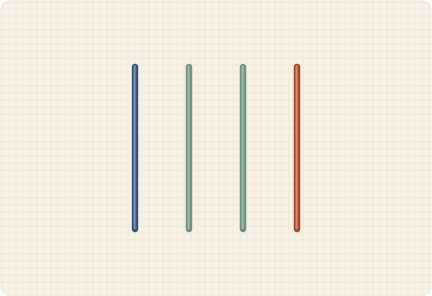
Lay out four ends
Clip the four ends in order. Hold the two center cords straight and leave the outside pair free to move.
Form a flat square knot and see what happens when the same half-knot is repeated.
Work the steps ↓ Browse 14 techniques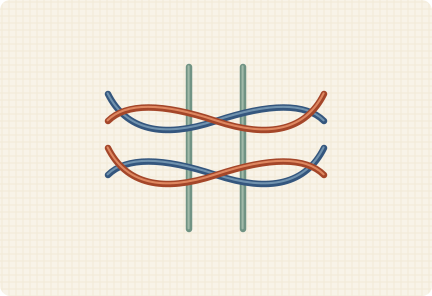
Clip the four ends in order. Hold the two center cords straight and leave the outside pair free to move.
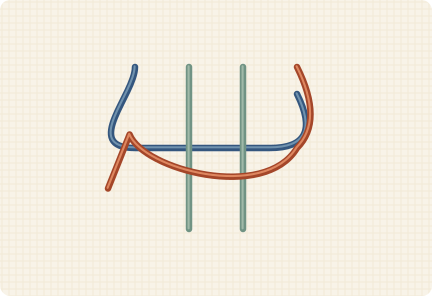
Take the left cord across the center pair under the right. Pass the right behind the pair and forward through the left loop. Tighten evenly.
Begin from the right and mirror the route. Slide this half up to the first and flatten the knot.
The same outer cord started successive half-knots. Check the side of the last ridge.
Mount four working ends. Tie a square knot by reversing the starting side for its second half. Add one more half knot below it and mark which side starts the next group. Compare the direction of the cord ridge with a plain square-knot chain.
Bring the chosen ends into a single bundle at the marked height. Wrap and secure the gathering cord without crossing the loose ends. Spread the ends again below the knot before starting the next group.
Plaited knots are formed by a continuous repetition of the first crossing of the threads for making a flat knot, detail a; waved knots by a slight twist given to the plaited knots from left to right, detail b. These plaits of waved knots are secured by joining together the threads of opposite meshes, two and two, by a flat double knot.
Two plain crossings of the threads, detail a, to begin with; after which you rapidly reverse the threads, turning the knot to the wrong side, drawing it up tightly at the same time; this forms the first knot, detail b. For the following knots tie the threads together, as for the flat double knot, detail c.
Looped picots are made along a row of knots by setting the knots, far enough apart for the loop between, to form a picot when the knots are drawn up close together.
These picots are always made on both sides and can be repeated several times along a row of knots. Detail a shows the crossing of the threads for the picots, detail b the picots completed and followed by a flat knot.
A bead knot is made by turning back the threads after a row of flat double knots. Detail a shows three flat double knots finished, detail b the inner threads turned back over the flat double knots, detail c the two knotting threads, brought between the two threads coming from the left to the right, and detail d the bead knot finished and followed by a flat double knot.
These knots must be as close together as possible. This done, begin to make the slanting bars, inclining from left to right, with 4 threads.
Represents threads 2, 3 and 4, knotted thread 1 and in the second bar, thread 2 becoming in its turn the cord, and having threads 3, 4 and 1 knotted over it, while it is being held, tightly stretched in the right hand.
Here, it has to be the left hand that holds the thread extended from right to left, while the right hand does the knotting.
Explains how the double bars are bound together by an ordinary double knot.
Pin two differently colored cords at the top. Hold the left taut and knot the right over it. Switch their roles at the next knot. Repeat, watching the alternating colors down the edge and measuring the width after every few knots.
Pair four cords into two groups. Hold one pair as a single carrier and tie the other over it. Swap roles at each knot as for a two-cord chain. Keep both strands within each pair parallel and check the finished width against the single version.
Here, the same cord runs back and forth; the 4 threads that hang down, form little ribbed bars running right and left. To distinguish from the knotting threads, the thread that runs back and forth it, is represented in a darker colour.
Then continue the bars in the opposite direction, so that the 2nd thread on the left is stretched over the right hand group of threads, and the 11th thread on the right over the left hand group.
The other bunches of threads which are hung on between two bars of knots must be tied on the same level with the first, but do not, nevertheless, come into close contact with the bars.
Begin by making all the knots over threads 1 and 2 of the left set, so that threads 3 and 4 on the left will be outside and threads 1 and 2 inside the group. Make the same knots over the 3rd and 4th thread on the right, then repeat the left group again and so on.
Cut 8 double threads of the length the gimp is to be.
These shuttles simplify the work enormously and are made hollow so that they can be mounted and filled on the spindle of any sewing machine.
Knot on the threads, and make a single bar of knots. Then leaving 2 threads on the right and 2 on the left disengaged, make 3 flat double knots with every set of 4 threads between. Make a slanting bar of double knots over the 16th right thread, with the 15th, 14th, 13th, 12th, 11th, 10th and 9th thread; then make knots with the same threads and with the 16th over the 15th thread. Make a similar bar on the left, over the 1st thread, with the 2nd, 3rd, 4th, 5th, 6th, 7th and 8th thread.
Knot the threads on for both these borders in the ordinary way, followed by a single horizontal bar of knots.
The same pattern can also be used as an insertion: bags for instance, look very well made of alternate stripes of this insertion and stripes made of flat knots.


