
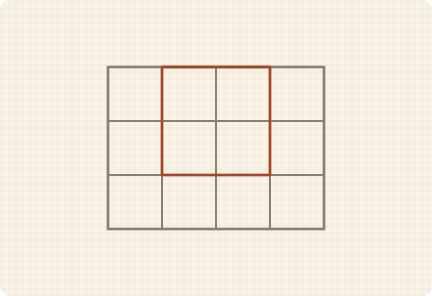
Step 1 of 3
Plan four cells
Count an open frame around a two-by-two group. Mark which cells will be filled before adding thread.
Make a small repeat that alternates open mesh, outlined lines and a denser filling.
Work the steps ↓ Browse 23 techniques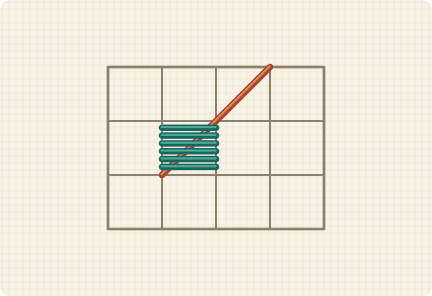
Count an open frame around a two-by-two group. Mark which cells will be filled before adding thread.
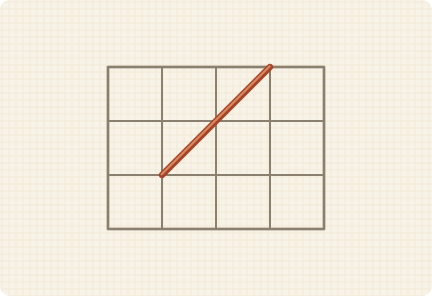
Run a fine thread through the bars along one diagonal. Carry it around a junction at every change of direction.
Weave a heavier thread across selected cells. Leave neighboring cells open so the repeat reads clearly.
The outline or the filling is drawing opposite mesh bars together. Release tension where the first distortion appears.
In the first row you carry the thread over one bar and slip it through behind a knot; in the second you do the same thing, only that above, your needle will pass under 3 threads, two of them the threads of the loop of the first row and the third a bar of the net. In every square 4 threads cross each other.
This stitch, which forms a close waved ground, is produced by passing the thread in each row of the netting over a square and behind a knot.
Begin by covering the whole surface to be embroidered with plain loop stitches, then stretch threads diagonally across the squares of the netting and the loop stitches; one set of threads running over the stitches and under the knots of the netting, the other under the first and second threads of the loop stitches and over the first crossed threads and the knots.
Make half cross stitches over 4 squares of netting, by passing the thread alternately over and under 3 knots, and under 3 squares of the netting.
Cover a whole row of squares with cross stitches and leave 3 rows of squares empty. When you have a sufficient number of rows of cross stitches, take a long needle and pass it upwards from below, and from right to left, under the two bars of the third upper square; then pass downwards to the first square of the 3 bottom rows and under the bars from right to left, so as again to leave 3 squares between the fresh stitches. The next row of stitches is made in the same manner, so that the stitches are not only set contrary ways but reciprocally cover each other.
Begin by running the thread, back and forth, under two vertical bars and over three horizontal ones. When the ground is entirely covered, carry your thread from right to left, under the bars over which the first rows of threads are crossed; then take it over the long crosses, that correspond to 5 squares of netting, and pass it in the same line under the bars of the netting. In coming back, the long stitches cross each other over the stitches of the first rows.
Pass the thread from left to right, under a bar of the netting, carry it downwards over 4 squares and pass it again, from left to right, under the bar, then upwards, again over 4 squares of netting and so on. The stitches of the next rows are made in the same manner; you have only to see that the loops formed by the stitches all come on the same line of knots.
Wherever two sizes of thread are used for one pattern, all the stitches in the coarse thread should be put in first and those in the fine, last.
You begin with the coarse thread and finish all the wheels first, making them each over 4 threads of the netting; then with the fine thread, you make loop stitches between them, in rows.
The darning stitches are made in the coarse thread, over 4 squares of the netting, in a horizontal direction, with loop stitches, in the fine thread, made between them, over the same number of squares.
Carry the coarse thread, from right to left, under the first knot of the netting, and then under the next, from left to right.
When the whole foundation has been thus covered, take the fine thread and make loop stitches in the squares between the other rows of stitches, passing the needle for that purpose over the double stitch. Lastly, intersect the loop stitches with straight threads and pass the needle each time through the knot of the netting.
Mark alternate mesh cells. Work small crosses in one yarn weight in the first group. Use a fuller thread to add a second group of stitches above them. Compare the relief and how much empty ground remains visible.
Fill every other square densely with darning stitches. Cross the empty squares with corded diagonal threads. Keep the diagonals lighter than the filled cells so the checkerboard remains visible.
To make a really satisfactory grounding of this kind, you should be careful always to carry your thread over the bars of the netting and under the threads that are stretched diagonally across.
To give them the right shape, finish all the rows of stitches one way first; in the subsequent rows, that cross the first ones, you introduce the thread between the stitches that were first crossed.
Fasten the thread to a knot of the netting, then carry it, always diagonally, under 3 other knots and repeat this 3 times, after which, carry it once round the bar of the netting, to fasten it, and back again to the knot which it already encircles, and from thence begin a new square. Owing to your having always to bring the thread back to the knot whence the next square is to begin, you will have 4 threads on two of the sides and 6 on the two others.
In the second and subsequent rows, the needle has to pass twice under the angles that were first formed, in order that, over the whole surface, all the corners may be equally covered and connected.
Mark the two long edges of a strip of net. Darn selected cells with even parallel passes, returning through alternate crossings. Keep the outermost row of cells available to join the strip to the cloth.
Use a coarser thread for the main darned lines and a finer one for the subsidiary pattern. Work adjacent repeats before judging the contrast or filling the remaining surface.
Large pieces of embroidered netting are generally made up of squares and stripes, joined together with ribbon and fine linen insertions. It is easier and less cumbrous to make the netting in separate pieces.
The same material in Rouge-Géranium, is used for the little centre squares and the pink crosses, and isolated darned squares are framed with loose cord stitches in Coton à repriser colour Jaune-vieil-Or 680.
In order to make the isolated loop stitches, the thread which forms the cross in the middle must be carried to the middle of the bar, the loops that form the stitches must be finished and the thread carried back to the knot whence it started. It must then be taken three times backwards and forwards over the foundation thread and the two bars of the netting, when the stitches, into and over 3 squares of the netting, should be made.
The edging, to match the square, is worked in the original in pale shades, in contrast to the square which is executed entirely in écru thread. The squares in the netted footing of the lace are loosely overcast with pale Violet-Mauve 316, the same colour is also used for the wheels in the outside edge, each of which fills a square, and for the loop stitches round them; while the middle one of the three upper ribbed wheels and the star are worked in dark Violet-Mauve 315.
After several experiments, the best result has been arrived at, and the Turkish cord in which the original is made, has now been manufactured for netting purposes, as well as for other kinds of decorative work, already alluded to, and referred to again later on.
Any netting pattern can be copied in this braid, and the simplest piece of work of the kind is worth mounting on a rich foundation of silk, brocade, velvet or plush.

