
Guide
Stitching in hand versus on a frame
Compare stitching in hand with stretcher bars or a scroll frame, including tension, portability, reverse access, and decorative stitches.
Stitching in hand keeps the setup compact and lets you reposition a small canvas freely. A frame supports the ground so you can concentrate on thread placement, often with less need to hold the canvas tightly. Neither approach removes the need to watch the grid and maintain even stitch tension.
Choose by looking at the design, canvas size, stitch structure, and how your hands naturally work. A method that is convenient for a small field of tent stitch may become awkward with long parallel stitches or a heavy canvas.
What changes when the canvas is supported
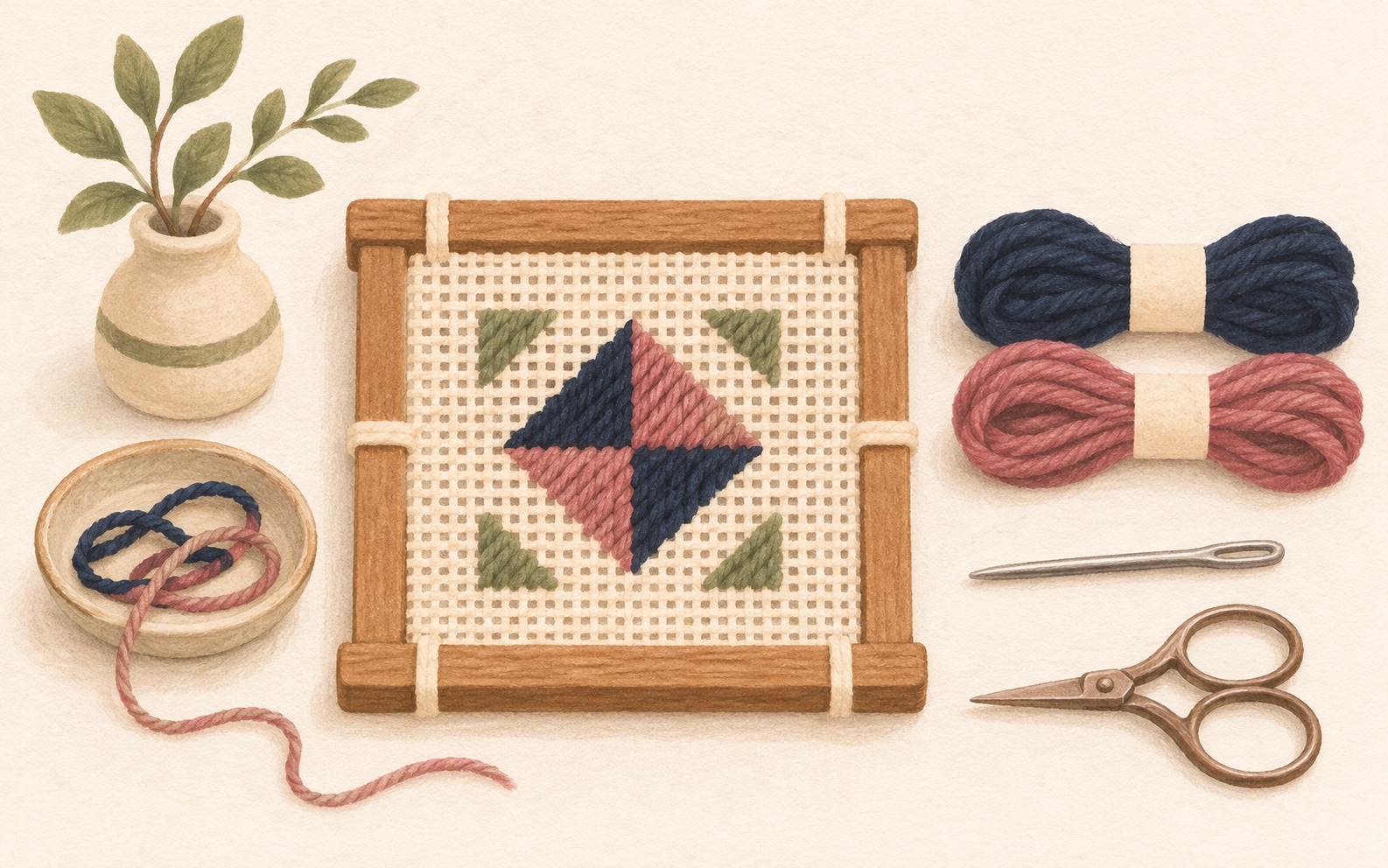
With the ground held flat, you can bring the needle up and then take it down as separate movements. Needlepoint Now calls this the stab method. It gives you an opportunity to see the thread before it settles, and a stand can free the other hand for a laying tool.
The tradeoff is size and access. Check whether you can comfortably reach the center and turn the work to secure a tail. Some supports rotate; Needlework System 4’s scroll frame is one example. Other setups require you to lift or release the frame.
What to watch when stitching in hand
Support the canvas without gripping a narrow corner so hard that the grid bends. Reposition the work as the stitched area grows, and avoid repeatedly creasing the same line. If you use a scooping movement that enters and exits in one motion, verify the reverse path rather than assuming it duplicates a diagram taught with separate movements.
Check the canvas against a square reference occasionally. A piece can feel comfortable in the hand while gradually becoming a parallelogram. A support may help you notice that change earlier.
A useful comparison exercise
Work the same small shape on two pieces of spare canvas, using the same thread preparation and stitch. Support one piece and hold the other. Compare the effort of reaching the holes, visibility of the reverse, grid alignment, and ease of stopping to correct a stitch.
This is a handling comparison, not a contest for the fastest method. If the supported version feels cumbersome, adjust its position before rejecting it. If the hand-held version encourages a tight grip, a smaller practice area or a different support may help.
For designs with open areas, long stitches, or several laid strands, support is particularly worth considering. Read when a laying tool helps and arranging a comfortable stitching setup to choose a system that lets you see and control the stitch without fighting the canvas.
Keep learning
Learning path
Your first needlepoint canvas: a learning path
Follow a linked beginner path from choosing a canvas and planning its finish to starting threads, stitching, and checking your first project.
Guide
Choosing a first needlepoint project
Choose a first needlepoint project by comparing design complexity, mesh, included supplies, finishing needs, and a practical buying checklist.