
Step 1 of 3
Find the holes
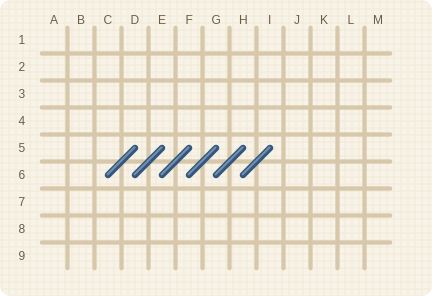
Mark a baseline across six intersections with waste thread. Locate the holes immediately below and above a single intersection.
Count canvas threads between holes and compare one-by-one, one-by-two and two-by-two diagonals.
Work the steps ↓ Browse 10 techniques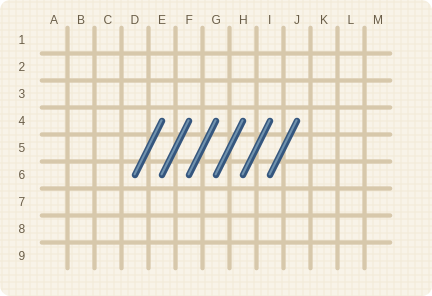
Needlepoint uses a countable ground. On single-thread canvas each grid thread stands alone. On double-thread canvas the threads run in pairs. Mark one counted unit before beginning so that your horizontal and vertical spans use the same scale.
Mark a baseline across six intersections with waste thread. Locate the holes immediately below and above a single intersection.
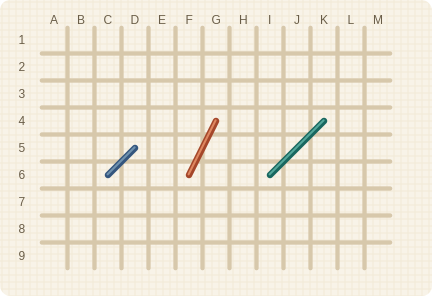
Make one diagonal over one thread each way. Beside it work one across and two up, then two across and two up.
Choose one span and shift the starting hole one thread to the right for each new stitch. Keep the end points level.
Count the threads crossed between the entry and exit holes. Counting the holes themselves adds one.
Give a chart and a blank canvas the same starting point. Two removable guides let you count out to a roofline or the center of a face.
Pull a sample strand through ten holes in the intended canvas. It should cover the ground without scraping its color or forcing the holes apart. Compare wool and cotton at the actual stitch length.
Build a row of small crosses in two passes. The direction of the top leg determines how the whole row catches the light.
Carry a foundation strand along the row. From left to right, cross it with single diagonal half stitches. Keep the front legs parallel and the laid strand covered as the row grows.
A taller diagonal makes a narrow, continuous band. Count its height and width separately to keep the angle steady.
Find the paired threads of Penelope canvas. Mark a starting hole between pairs and test a blunt needle that passes without splitting the strands. Use the same counted opening for each tall diagonal.
Give a sample a ribbed appearance with shallow diagonals built in vertical lines.
Use a small diagonal stitch to describe an eye, a thin edge or a change of color on counted canvas.
Let adjacent diagonal stitches overlap to make a close-set fill across a band.
Use an elongated cross to make a tall counted unit with a clear center.

