
Step 1 of 3
Build to the center
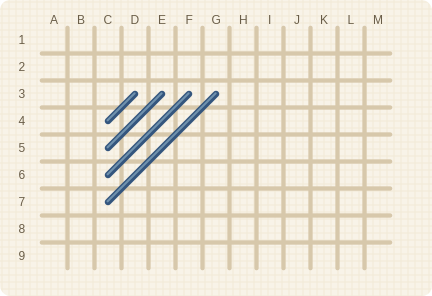
In a square bring each diagonal up from lower left to upper right. Lengthen successive stitches toward the longest central diagonal.
Form a Scotch-style diagonal block, then compare the effect of touching and separated blocks.
Work the steps ↓ Browse 9 techniques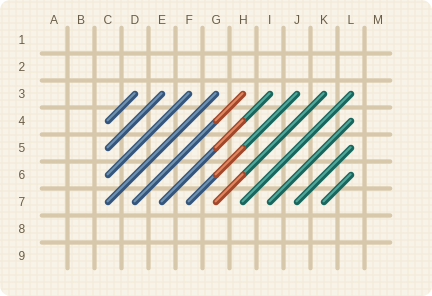
In a square bring each diagonal up from lower left to upper right. Lengthen successive stitches toward the longest central diagonal.
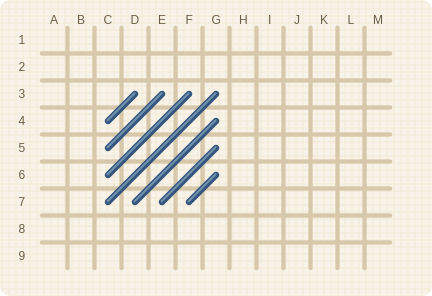
Decrease the span symmetrically on the far side. Check that the four corners of the block fall at the marked limits.
Try one touching block and one separated by a strip of Gobelin stitches. Compare the stair-step and framed effects.
The rising and falling spans do not match. Count out from the longest diagonal on both sides.
For the historical counted variation, build the diagonal spans in the sequence one, three, five, three, one. Set a row of Gobelin stitches between neighboring squares. Compare with the graduated block in the workshop.
Build adjoining squares of parallel diagonal stitches. Move the second square up a step so the corners meet. Place Gobelin dividing stitches along the sides of the stepped band.
Work four parallel diagonals increasing from one to four double threads. Repeat the triangular group without filling its gaps. Use Gobelin stitches over two threads to fill the open spaces afterward.
Work four uprights over six horizontal threads. Pull them into a group with a central backstitch. Run a contrasting thread twice through the center catch and fill the ground between shells with backstitch.
Make six stitches one below the other and six beside one another, each over two double threads. Repeat the downward and sideways arrangement on the next row over one double thread.
Build a stepped band with six stitches in the downward group and six in the sideways group. Sample the arrangement over two threads and over four, and compare the scale before choosing a ground filling.
Lay out four rows with paired diagonal spans of four and one, three and two, two and three, then one and four. Keep the five-unit total while shifting the longer stitch across the repeat.
Make each loop over a smooth narrow gauge and secure it at the base with a cross stitch. Remove the gauge after a short row and test each anchor before deciding whether to leave the loops intact.
Bring the thread up and return through the same hole, leaving a loop. Bring the needle up two threads lower inside the loop. Catch the loop with the next stitch and keep the links rounded.

