
Step 1 of 3
Plot a unit
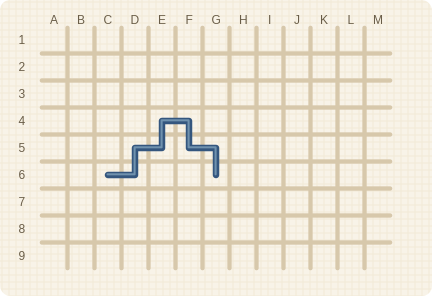
Draw a stepped branch four cells wide. Count from its first hole to the first hole of the following branch.
Fit a repeat, a corner and an inner motif into one original canvas sampler.
Work the steps ↓ Browse 14 techniques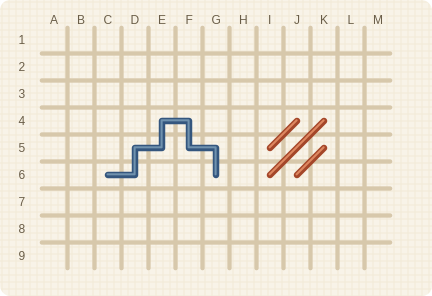
Draw a stepped branch four cells wide. Count from its first hole to the first hole of the following branch.
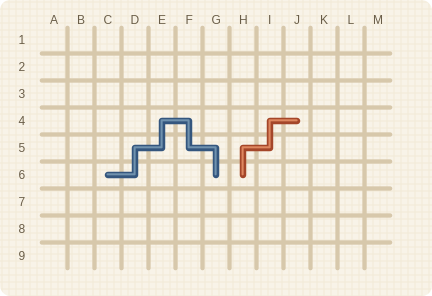
Rotate the unit a quarter turn on paper. Reserve its corner cells before dividing the straight runs into whole repeats.
Place a small diagonal block at the center and connect it visually to the border with the same accent color. Stitch a corner trial first.
Adjust a separator or resize the straight run on paper before placing the first permanent stitch.
Mark two parallel edges three threads apart for a trial. Plan the diagonal connections first, then mark the longer six-thread horizontal spans. Work a short join and inspect the reverse before committing to a full-width insertion.
Draw a stepped silhouette on squared paper and repeat it along a band. Compare a one-color sample with a two-color version whose outside stitches are darker than the filled center.
Use a dark red cross for the main landmark, alternate blue and green in lighter positions, and reserve yellow for highlights. Count the diagonal separation before repeating the group.
Mark a stepped line that can be followed in both directions. Work alternating segments outward and fill the gaps on the return. Check the corners on both faces before repeating the strip.
Trace a right angle on squared paper and choose a turning hole shared by its two arms. Use the darker shade inside and test the lighter outline outside it. Repeat the unit around the corner on the reverse journey.
Draw a small flower above a narrow stem. Work the stem as a continuous stroke-stitch route and add the petals on a return journey. Repeat in a single deep red so the line carries the pattern.
Mark parallel sloping stems in one color. Leave between them the space needed for the largest spray. Alternate short side branches along the stems and test how the repeat meets the edge.
Assign cross stitch to the solid areas of a small motif, stroke stitch to its lines and star stitches to the accents. Repeat it in open space and preserve enough gap to distinguish the stars.
Mark a stepped leaf outline in a dark color. Work its two halves in related reds with different stitch directions. Check that the division reads clearly without adding a heavy line along the middle.
Choose a small motif that has an identifiable center. Place that point at the center of the fabric, then repeat outward in opposite pairs. Check how much of the motif is left at each edge.
Mark a main stripe between two narrower stripes. Divide the central shapes with upright stroke stitches, then test small diagonal Gobelin blocks against the outlines before distributing the accent colors.
Choose three values of a color. Use the darkest for a narrow boundary, the middle for the main repeat and the lightest for a highlight. Stitch one full repeat and inspect it in ordinary light.
Lay out a band of overlapping counted stitches with a separate row of branches along its lower edge. Mark each branch junction before filling the band so the connectors remain even.
Center a small star of closely set Gobelin stitches in a square. Mark a mirrored branch on either side in stroke stitch. Sample one quarter and its corner before repeating the design across the mat.

