
Stitch
Basketweave tent stitch
Work a numbered basketweave field, understand its alternating reverse structure, and handle row turns and a stepped boundary.
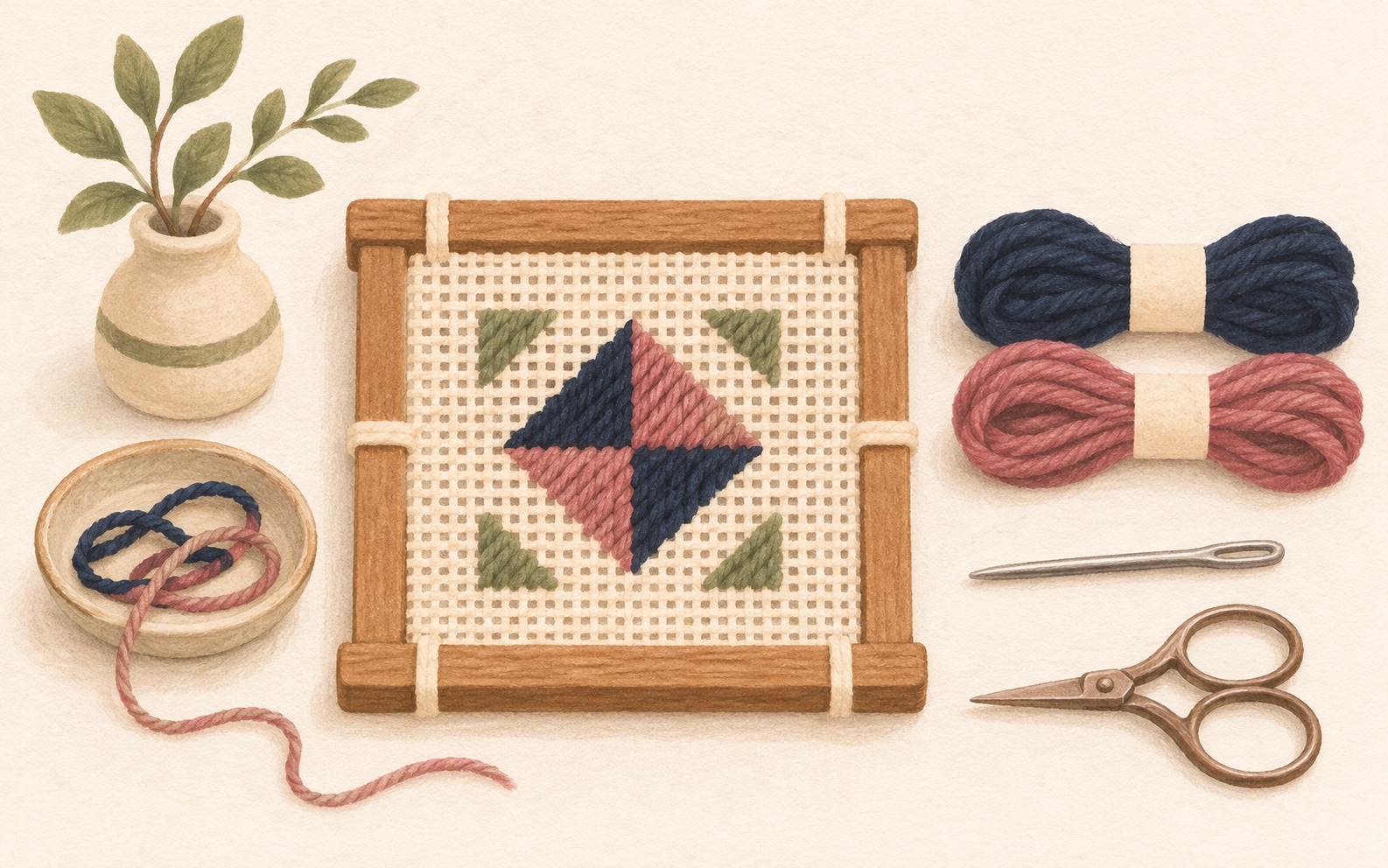
Basketweave is tent stitch arranged in diagonal runs. Its front consists of small diagonals; its reverse alternates horizontal and vertical travel. That back structure is why a front-only photograph cannot distinguish it reliably from continental or half-cross.
A complete four-by-four exercise
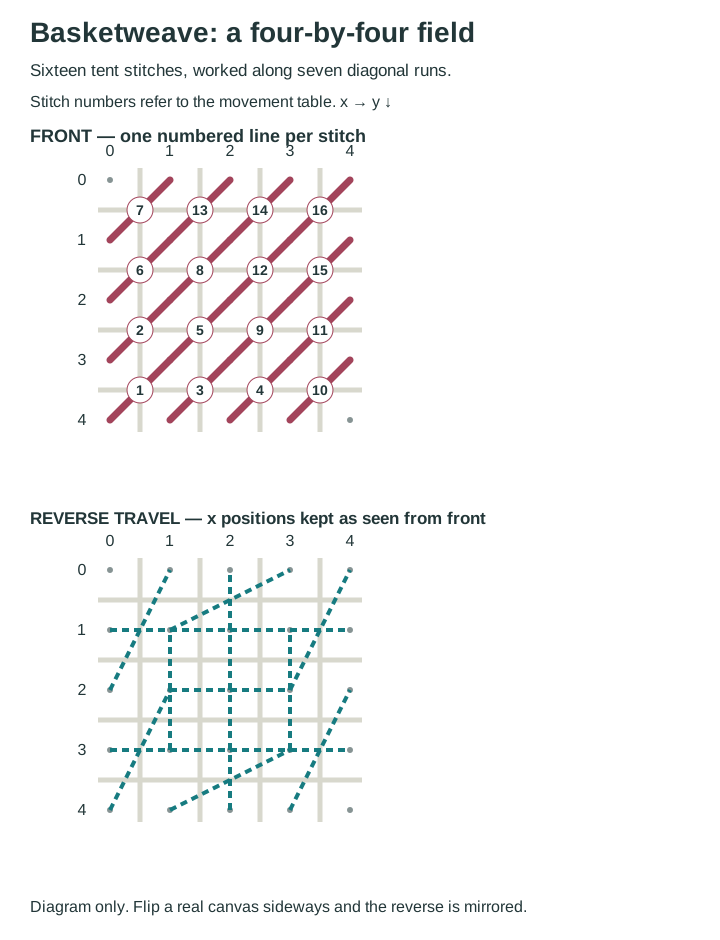
The diagram fills 16 intersections. Hole coordinates start at the upper left; x increases rightward and y downward. Here every stitch comes up at the upper-right hole and goes down at the lower-left hole of its intersection. The visible slant remains the same as the other tent stitches. Begin at the lower-left corner and follow the numbered diagonal runs.
| Stitch | Needle up (x,y) | Needle down (x,y) |
|---|---|---|
| 1 | (1, 3) | (0, 4) |
| 2 | (1, 2) | (0, 3) |
| 3 | (2, 3) | (1, 4) |
| 4 | (3, 3) | (2, 4) |
| 5 | (2, 2) | (1, 3) |
| 6 | (1, 1) | (0, 2) |
| 7 | (1, 0) | (0, 1) |
| 8 | (2, 1) | (1, 2) |
| 9 | (3, 2) | (2, 3) |
| 10 | (4, 3) | (3, 4) |
| 11 | (4, 2) | (3, 3) |
| 12 | (3, 1) | (2, 2) |
| 13 | (2, 0) | (1, 1) |
| 14 | (3, 0) | (2, 1) |
| 15 | (4, 1) | (3, 2) |
| 16 | (4, 0) | (3, 1) |
Understand the turns instead of memorizing all 16 numbers
Stitch 1 is the first corner. Stitches 2–3 make a run down and right. Stitches 4–6 return up and left. Stitches 7–10 run down and right; 11–13 return up and left; 14–15 run down and right; stitch 16 closes the last corner. These are diagonals through the grid, not horizontal rows.
Within a down-right run in this diagram, the reverse links are horizontal. Within an up-left run they are vertical. Check one example: after stitch 7 goes down at (0,1), stitch 8 comes up at (2,1), a horizontal move. After stitch 11 goes down at (3,3), stitch 12 comes up at (3,1), a vertical move. The RSN basketweave reference explains the same alternating reverse structure. Short changes at the run ends are part of turning.
Anchor and keep your place
Use a short practice length and an away knot on the front outside the exercise, leaving a tail long enough to thread later. Once a dense patch exists, remove the temporary knot and bury its tail beneath several stitches on the reverse. End the working thread under existing stitching, checking that it holds without tightening the front. Thread starts and thread endings cover the practical choices.
When pausing, write down the last completed number and whether the next diagonal goes up-left or down-right. A small removable note beside the canvas is safer than guessing from the front when you return. On mono canvas, the over-and-under weave can also help maintain the usual “up the poles, down the steps” orientation; do not rotate the canvas mid-patch and assume that a memorized direction still applies.
Try a stepped boundary
On another four-by-four outline, allow four intersections in each of the top two rows, three in the third, and two in the bottom row, always counted from the left. The lower-right corner is now missing. Follow the same diagonal order as the full diagram, skipping full-field stitches 4, 10, and 11 because their intersections are outside the new shape. There are 13 stitches left.
The surviving order is 1–2–3–5–6–7–8–9–12–13–14–15–16. A shortened diagonal ends at the shape’s boundary; the next diagonal begins at its boundary. Keep the position of every remaining stitch fixed instead of sliding a short run sideways. If a real painted edge creates separated islands, end and restart rather than making a long uncovered carry.
Check the result
Count four intersections across and four down in the full exercise. Look for consistent front slants, alternating reverse bands, and no pulled loops. A series of long diagonal reverse links suggests continental travel has entered the patch. For unexpected gaps or distortion, use the coverage diagnostic and the tension guide. The diagram applies to either 13 or 18 mesh; the thread setup must fit the chosen canvas.
Keep learning

Stitch
Continental tent stitch
Learn continental tent stitch with two numbered rows, exact needle movements, a clean return, and a narrow-band example.
Stitch
Half-cross tent stitch
See how half-cross differs from continental, then follow a numbered two-row exercise and inspect the short reverse links.
Troubleshooting case
Canvas showing through unexpectedly
Diagnose unexpected canvas gaps with a symptom table, a controlled coverage check, and clear limits on adding thread or removing stitches.