
Guide
Blocking: decide before adding moisture
Decide whether blocking is appropriate before adding water or heat, with a material decision table and a concrete finisher handoff.
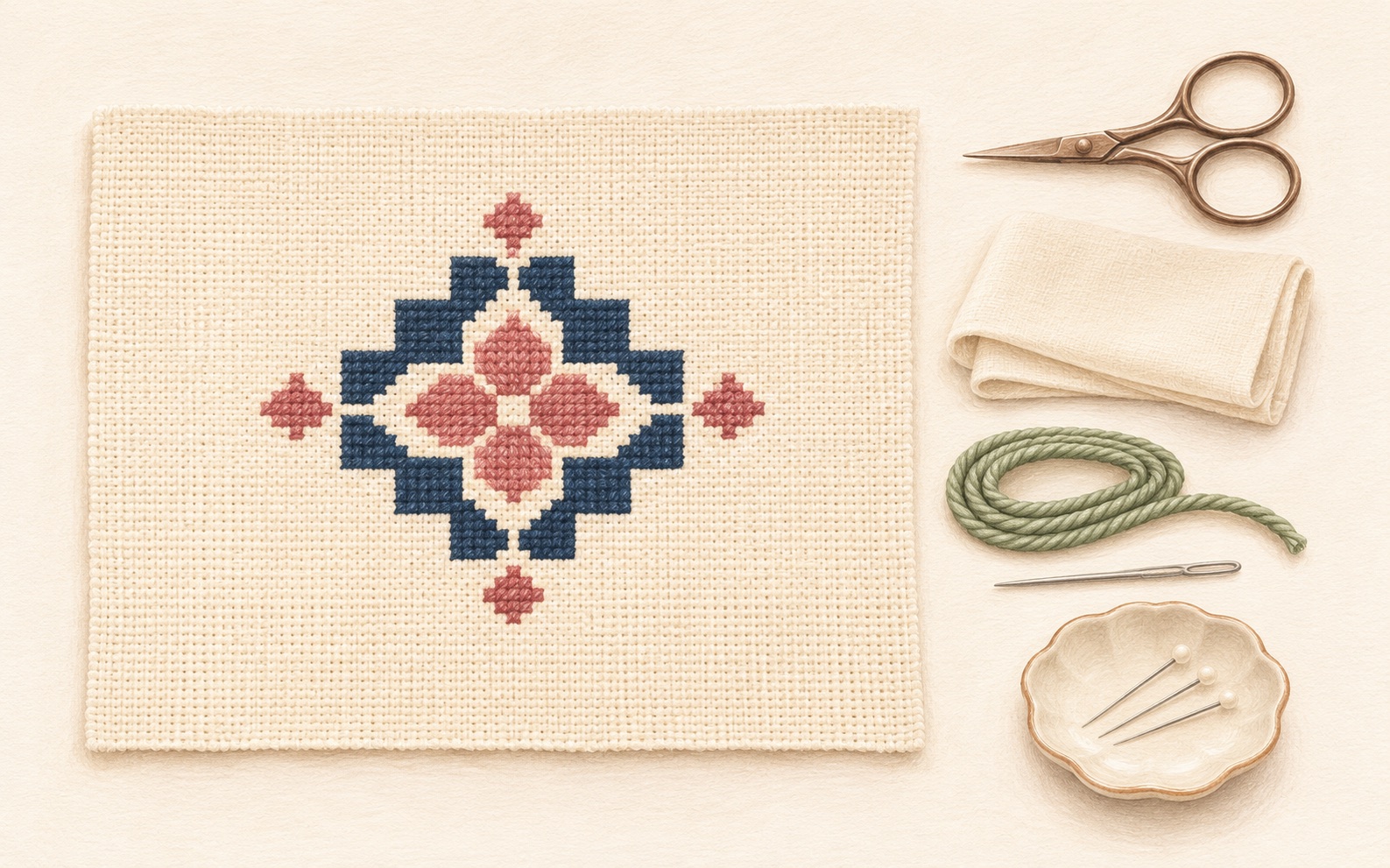
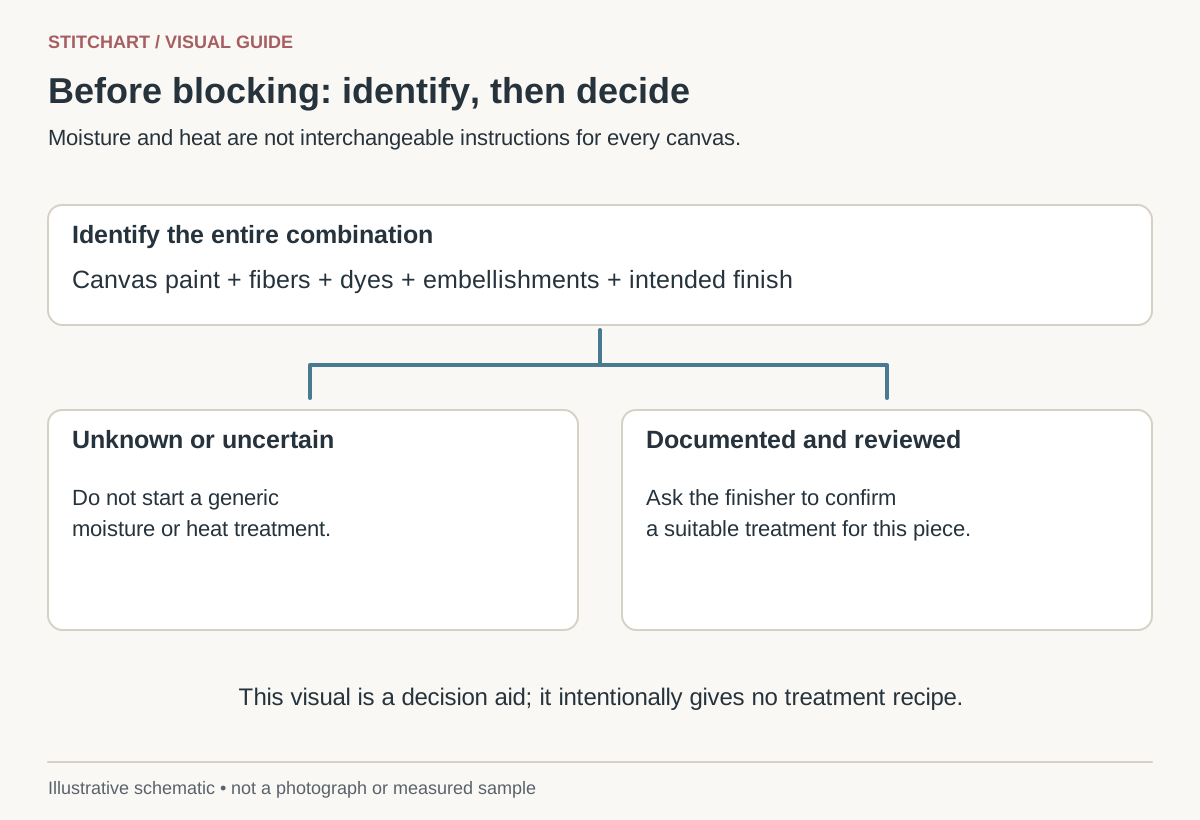
Blocking reshapes a completed canvas for finishing. The first decision is whether the materials and intended construction allow the proposed treatment. A generic spray, steam, or soaking recipe cannot answer that for an unidentified or mixed-material piece.
Make the decision from the whole canvas
| Situation | Next step |
|---|---|
| You know every material and have instructions for this exact kit | Check the maker’s guidance and the intended finisher’s requirements together |
| One thread, paint, bead, or adhesive is unknown | Keep the canvas dry while identifying it or requesting a finisher’s assessment |
| The piece contains mixed materials | Use the restrictions of the complete combination; one washable thread is not enough |
| The work is old, damaged, sentimental, or previously treated | Document its condition and consult a suitable specialist before experimenting |
| The finisher wants to do the blocking | Send it in the requested condition; do not pre-treat it to make it look ready |
The distinction matters even within cotton. DMC’s Soft Cotton page specifies dry cleaning and no washing, while another thread line may have different care. Appletons advises against washing its wool. A fiber name alone cannot establish an appropriate method.
Describe the shape before trying to change it
Lay the canvas down without stretching it. Photograph the front and back with a ruler. Measure the stitched width at the top, middle, and bottom, and the height at the left, middle, and right. Note whether the grid is skewed, edges bow, or one area is tighter than another. Keep the nominal design dimensions separate from these observed measurements.
A design that is intentionally asymmetrical does not need to be made symmetrical. Nor does an unevenly cut margin prove that the stitched grid is distorted. Check the actual intersections and intended outline.
A practical handoff example
Suppose a small ornament uses pearl cotton, an unidentified metallic accent, and a painted canvas. You know the main cotton label but not the metallic’s care instructions. The useful next action is to send the finisher front/back photographs, the dimensions, and a description of the unknown accent. Keep the piece untreated while asking whether they want it on or off its bars. Do not choose a moisture method solely from the cotton label.
This example resolves the decision—who assesses the material combination—without inventing a universal treatment. If the finisher later gives instructions for that exact piece, keep them with the project record.
What to send the finisher
- Intended finished object and desired dimensions.
- Canvas maker and mesh; whether the design is painted, printed, or counted.
- Thread makers, lines, and any strand counts; identify unknown materials explicitly.
- Beads, metallics, adhesives, backing, repairs, and any previous washing or pressing.
- Front, reverse, and margin photographs with current measurements.
- The question: should I leave this untreated, and what preparation do you want?
Leave these decisions until the method is agreed
Do not trim margins, press directly on raised stitching, apply an untested cleaner, or force the canvas into a smaller frame opening. If a treatment is appropriate, its moisture, temperature, restraint, and drying requirements depend on the actual materials and method. This page answers the decision before treatment; it is not a heat or soaking recipe.
Use the finishing checklist to record the response. If the canvas is still being stitched and is progressively skewing, address tension and working support now instead of assuming a later block will compensate for continuing distortion.
Keep learning

Guide
Working with a professional needlepoint finisher
Prepare a clear needlepoint finishing request with a copyable form, a completed planning example, and shipping and return checks.
Learning path
Your first needlepoint canvas: a learning path
Follow a linked beginner path from choosing a canvas and planning its finish to starting threads, stitching, and checking your first project.