
Guide
Choosing quiet background stitches
Choose a quiet needlepoint background using contrast, repeat size, and sheen. Compare basketweave, mosaic, and Nobuko around a focal design.
A quiet background is not necessarily plain. It is a background whose contrast and texture remain subordinate to the subject. You can use a decorative stitch quietly, or make a simple tent-stitch field surprisingly loud with a strongly variegated thread.
Start by naming the focal feature: a monogram, animal face, flower, or central ornament. Then choose the background so that this feature remains the first thing you notice.
Begin with three candidates
Basketweave provides a compact tent-stitch field and is a useful baseline for a generous open area. Mosaic adds small grouped squares. Nobuko offers alternating short and longer diagonal elements.
These are candidates, not a ranking. A mosaic repeat can be too large in a narrow gap even when it looks restrained in a broad patch. Basketweave can still compete if the background color is much stronger than the subject.
Control one strong effect at a time
If the stitch has obvious texture, keep the thread’s color changes modest. If the thread has pronounced variegation, consider a simpler stitch. If the material is shiny, check whether the shine pulls attention away from a matte focal motif.
Imagine a red bird against a cream field. A cream basketweave background gives the bird clear edges. A cream mosaic field adds texture while retaining the same broad value relationship. Alternating cream and dark brown in every mosaic group introduces a new patterned subject, which may be more than the design needs.
Look at the narrow spaces
A background must work between a bird’s legs, beside a letter, and around a curved flower—not only in the largest empty corner. Count those narrow spaces before settling on a repeat.
Use compensation at curved boundaries to keep the background grid continuous. A decorative pattern should resume in the same position on the far side of a motif. Separate restarts can create distracting seams even when every local patch is neatly stitched.
On 13 mesh, a counted repeat has a larger physical footprint than on 18 mesh. If you are keeping the finished design size unchanged, the coarser version may need a smaller repeat or a smooth fill. More texture is not a requirement of larger holes.
Judge the whole composition
Look at the canvas from the distance at which the finished object will be used. Half-close your eyes if that helps separate broad light and dark areas. The main motif should retain a clear silhouette. If the background wins, reduce its contrast before trying a more complicated stitch.
The background can also be intentionally open, but exposed canvas adds another color and another surface to the composition. Treat that as a separate choice in open background planning. A successful quiet field does enough to complete the piece and leaves enough visual space for the subject to speak.
Keep learning
Guide
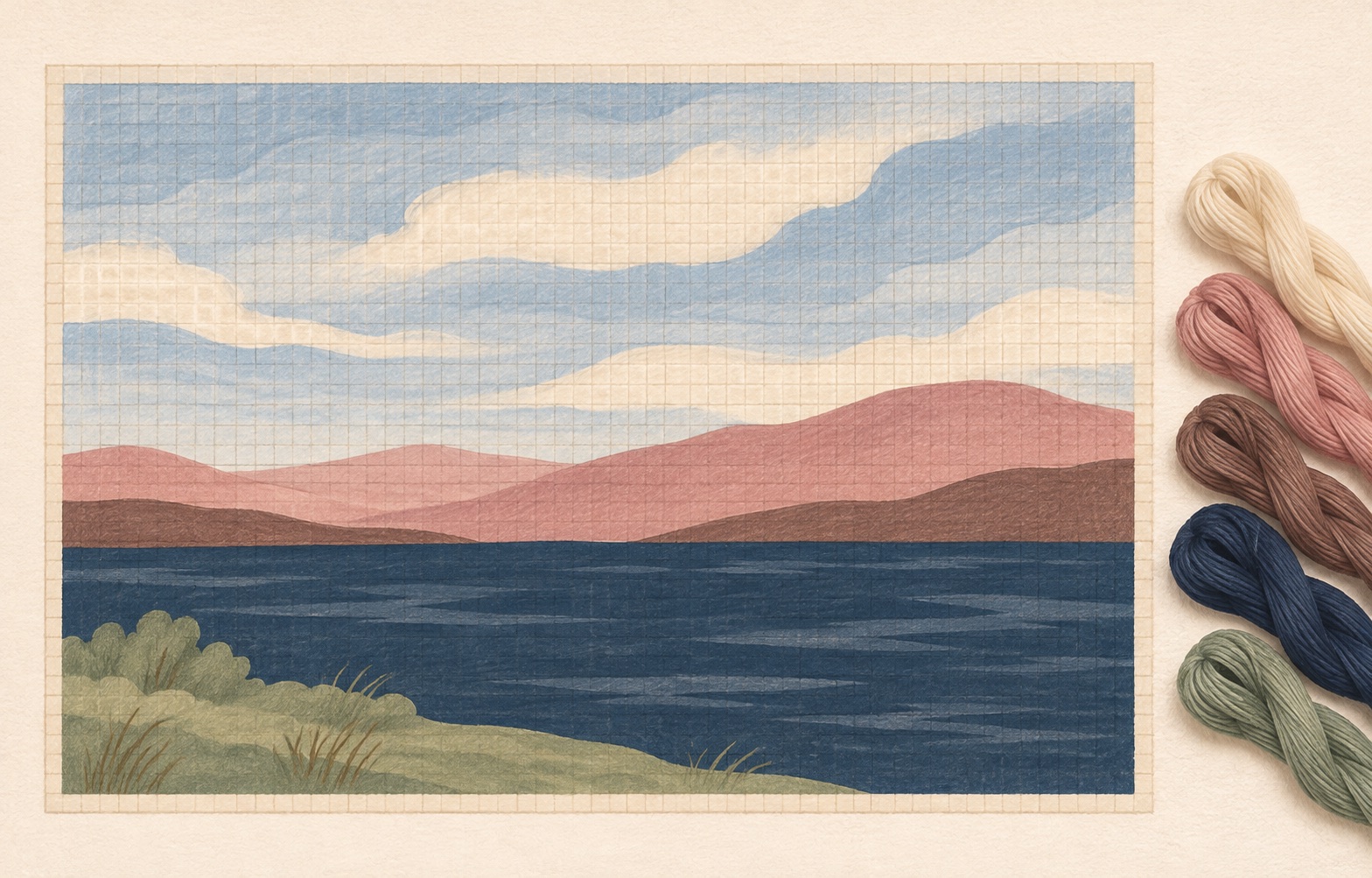
Choosing stitches for water
Choose between tent stitch, mosaic, and horizontal straight stitches for water, with a worked pond and shoreline example.
Guide
Choosing stitches for skies
Compare quiet tent stitch, mosaic, and an open sky treatment, then plan a roofline and cloud without breaking the design.
Learning path
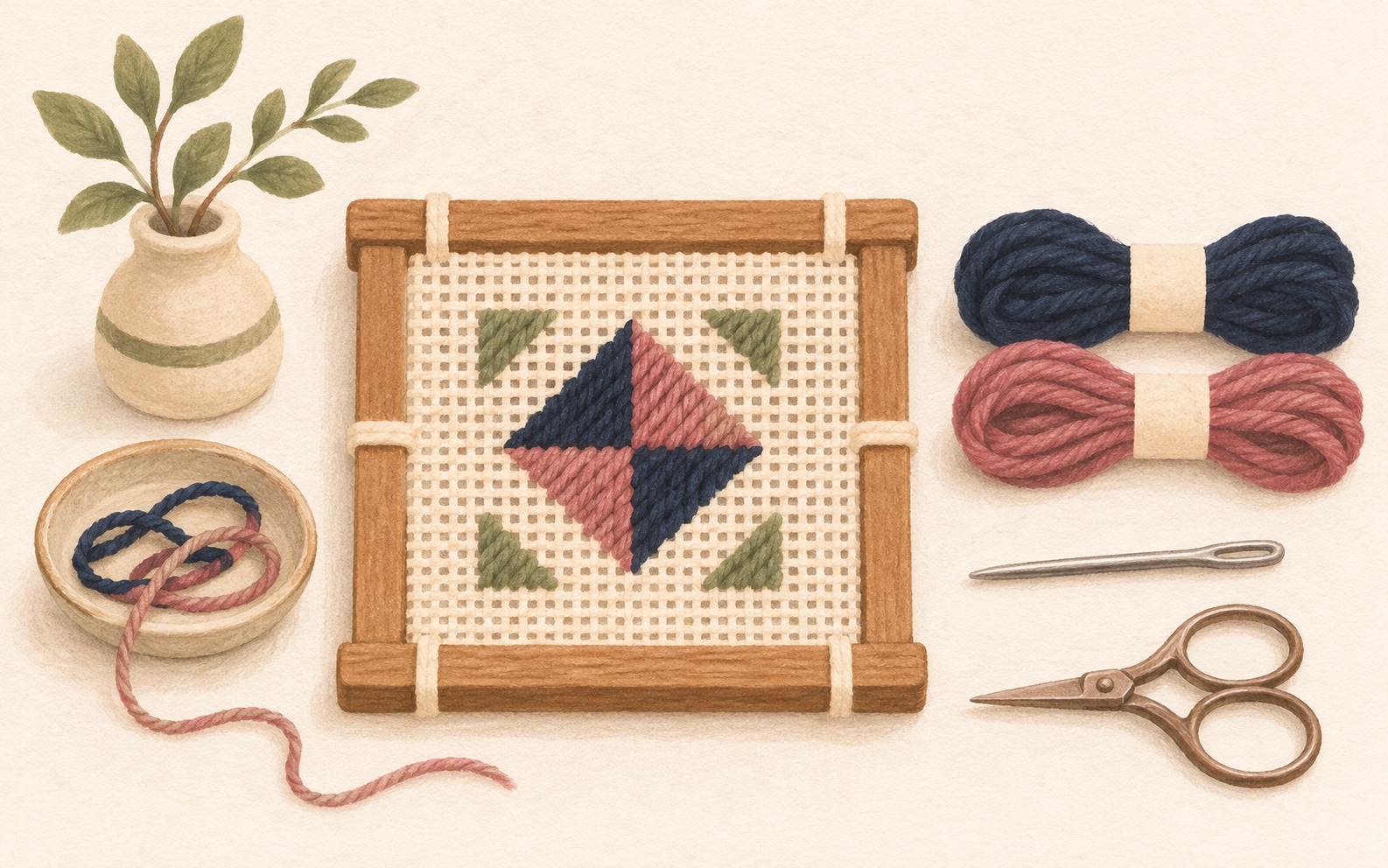
Your first needlepoint canvas: a learning path
Follow a linked beginner path from choosing a canvas and planning its finish to starting threads, stitching, and checking your first project.