
Guide
Choosing stitches for stone walls
Choose stone-wall stitches and colors that preserve irregular shapes. Includes a gate-wall plan, mortar choices, and ways to avoid distracting bands.
Stone walls range from regular cut blocks to irregular fieldstone. Identify which kind the painting shows before choosing a stitch. A repeated square pattern can suit dressed stone, but it may make a rough country wall look tiled.
Start by locating the largest stones and the deepest gaps. Let those establish the wall’s rhythm. Equal-sized accents distributed at equal distances will make an irregular surface look organized in a way the original design may not intend.
Use the stone shapes as the map
For a small wall, tent stitch can preserve irregular color shapes without adding another pattern. Give adjoining stones slightly different values where the painting needs separation. You do not have to surround every stone with a dark line.
A large stylized wall may use a decorative fill. Mosaic offers a grouped square surface, while Nobuko alternates shorter and longer diagonal elements. Choose one because of its effect on the wall, not because its name sounds rugged. If the repeat creates conspicuous bands, a smooth fill may be the better architectural choice.
Imagine a low fieldstone wall around a garden gate. Keep the largest pale stone near the gate’s base, place two darker stones farther along the wall, and leave the rest in related midtones. This unequal arrangement can suggest varied masonry without making every stone compete for attention.
The mortar is a separate decision. Dark mortar strongly separates the stones; a closer value produces a more blended wall. A one-intersection mortar path also consumes real space. When a tiny stone is mostly border, simplify the joint rather than filling the remaining center with an unsuitable large stitch.
Keep the wall continuous
When the wall passes behind a bush or post, plan its courses and color masses as though the obstruction were transparent. Rejoin the pattern at the correct height on the other side. A decorative repeat that restarts independently in every gap can make one wall look like several unrelated surfaces.
On 13 mesh, a small fieldstone may occupy only a handful of positions. Concentrate on its silhouette and value. On 18 mesh at the same physical scale, there may be room for a subtle inner change, but extra detail is optional. The stitch-scale guide helps decide whether the available space can support a full repeat.
Before stitching the darkest gaps, compare them with the gate, foliage, and building shadows. If the wall’s joints are darker and sharper than every other feature, the wall may dominate. Use the guide to combining stitches to keep the surrounding textures in balance.
A convincing rough wall does not require randomness in every stitch. It needs a few uneven relationships that remain consistent across the whole structure: larger and smaller stones, lighter and darker masses, and gaps that belong to the same wall.
Keep learning
Guide
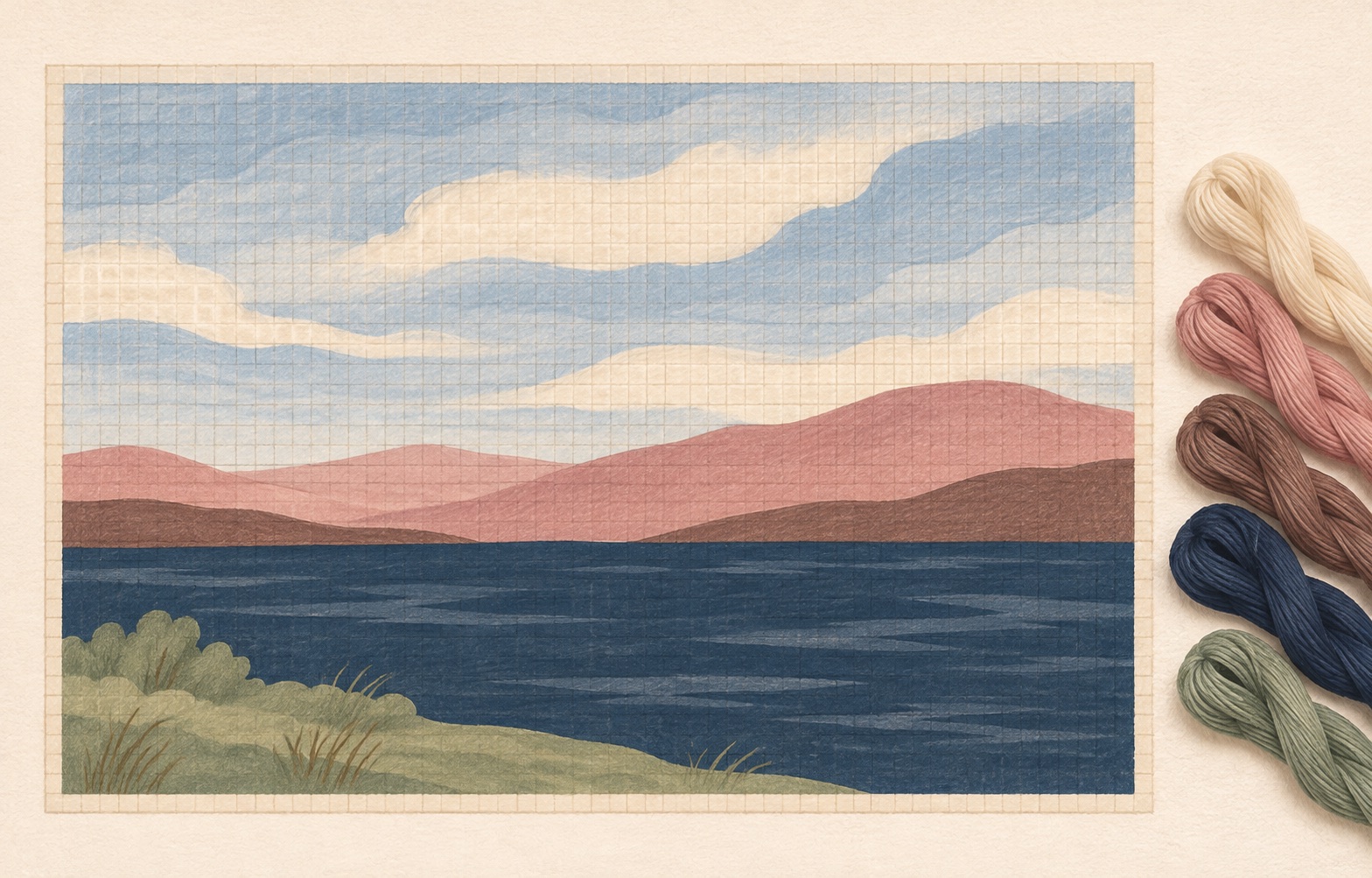
Choosing stitches for water
Choose between tent stitch, mosaic, and horizontal straight stitches for water, with a worked pond and shoreline example.
Guide
Choosing stitches for skies
Compare quiet tent stitch, mosaic, and an open sky treatment, then plan a roofline and cloud without breaking the design.
Learning path
Your first needlepoint canvas: a learning path
Follow a linked beginner path from choosing a canvas and planning its finish to starting threads, stitching, and checking your first project.