
The StitchArt learning library
Build your skills,
one stitch at a time.
Find a starting point, explore stitches and materials, and work through the details that make a project your own.
Explore the library
120 articles
Troubleshooting case
Crowded canvas intersections
Work through crowded needlepoint intersections without crushing nearby stitches. Check needle path, thread bulk, shared holes, and stitch sequence.
Troubleshooting case
Decorative repeats that do not fit
Fix a decorative needlepoint repeat that does not fit by checking its footprint, counting from landmarks, and choosing a deliberate partial-repeat plan.
Guide
Ending a thread without a bulky back
Learn a practical method for ending thread under existing stitches, choosing an anchor route, and avoiding bulky knots or visible tails.
Guide
Finding a comfortable stitching setup
Adjust your chair, canvas support, lighting, and tool placement with a practical setup check for short and longer stitching sessions.
Project
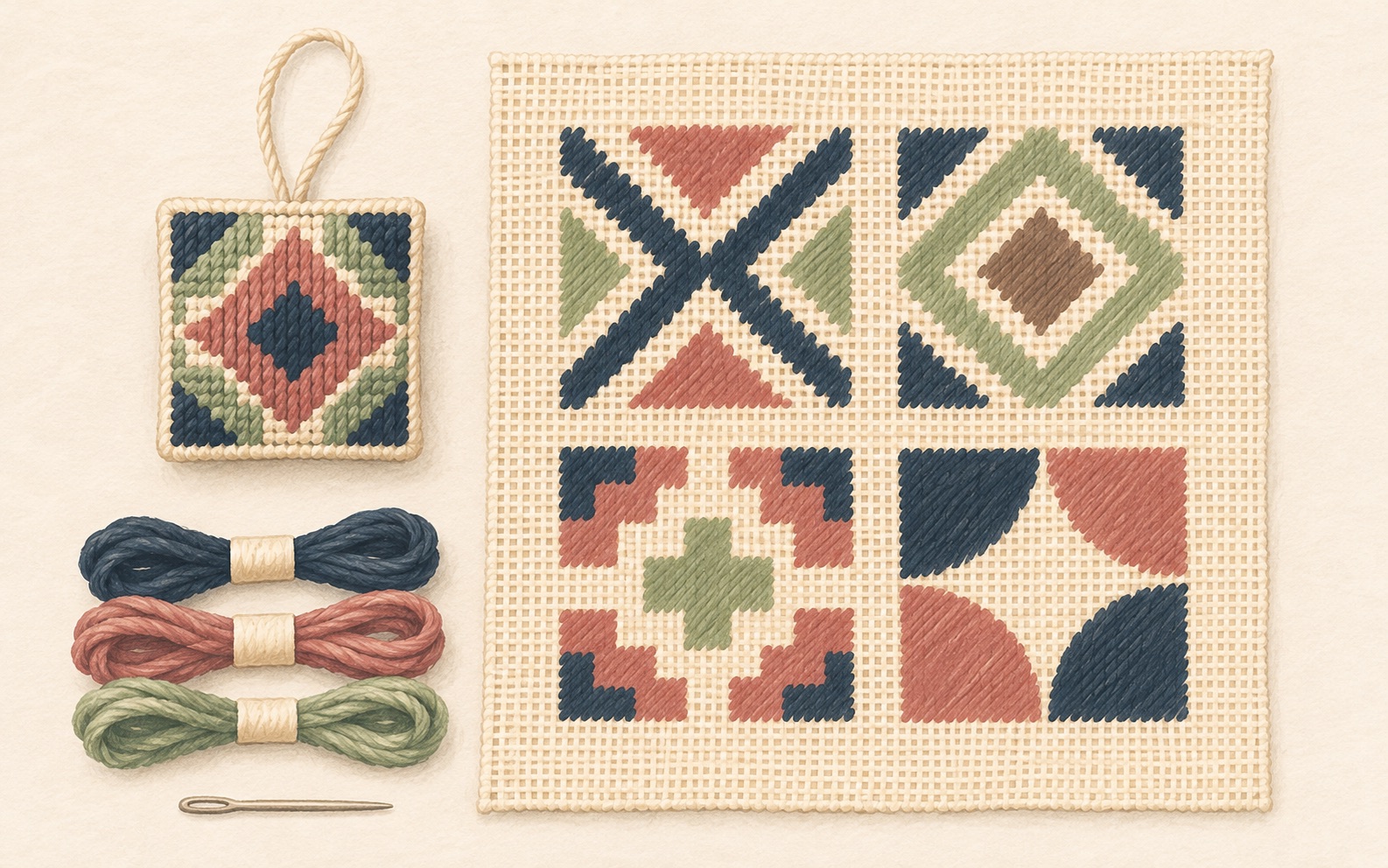
First ornament: a small geometric sampler
Stitch an original 26-by-26 geometric ornament with a printable chart, three-color key, exact stitch counts, and finishing handoff.
Learning path
From tent stitch to decorative stitches: a learning path
Follow a practical sequence from tent-stitch control through diagrams, repeats, row returns, compensation, and a small decorative project.
Stitch
Half-cross tent stitch
See how half-cross differs from continental, then follow a numbered two-row exercise and inspect the short reverse links.
Material
Interlock canvas
Compare interlock canvas with plain mono, understand its locked intersections, and check whether it matches your design and stitch instructions.
Guide
Keeping a thread and stitch journal
Use a simple project record for thread lines, colors, dye lots, strand counts, stitch choices, corrections, and restart notes.
Guide
Keeping stitch direction consistent
Understand front slant versus needle travel, avoid mirrored tent stitches, and check orientation when turning your canvas.
Material
Laying tools
Learn when a laying tool helps, how to guide a strand bundle, and how to avoid dragging, piercing, or over-tightening the stitch.
Guide
Left-handed needlepoint: using diagrams
Adapt needle movements for left-handed stitching while preserving stitch slant, numbered endpoints, and the orientation of the design.
Troubleshooting case
Loose loops on the reverse
Correct loose needlepoint loops before they become trapped. Identify recent slack, caught tails, and older loops while protecting the front stitches.
Troubleshooting case
Losing the place in a stitch diagram
Find your place in a needlepoint diagram with counted landmarks, complete-unit checks, and a simple pause-and-resume note that prevents shifted repeats.
Material
Magnification and task lighting
Evaluate task lights and magnifiers using your actual canvas, working distance, glare, field of view, stability, and color comparisons.
Guide
Making a small practice swatch
Plan a small sample with complete repeats, a boundary, labeled materials, and a clear decision instead of an uninformative patch of stitching.
Guide
Matching stitch scale to a painted area
Check needlepoint stitch scale with a counted-space method, repeat footprints, and 13-versus-18-mesh calculations before stitching a painted area.
Material
Metallic thread and blending filament
Compare fine blending filament with metallic braid, choose the role of the sparkle, and prepare a manageable needlepoint test area.
Troubleshooting case
Missed or doubled intersections
Locate a needlepoint counting error with anchor points, repeat footprints, and reverse-side checks. Decide how far to undo before continuing.
Material
Mono canvas
Understand mono canvas construction, compare13 and18mesh, and check grid alignment, color, support, and finishing needs before stitching.
Stitch
Mosaic stitch
Build a mosaic field from its 1–2–1 units, follow block and row transitions, and shorten a unit at a missing corner.
Guide
Mounting canvas on stretcher bars
Mount canvas on stretcher bars with a square grid, even attachment, usable margins, and controlled tension rather than excessive pulling.
Material
Needle minders and safe storage
Keep track of needlepoint needles during stitching, transport, and project changes with a simple count-and-store routine.
Material
Needle sizes and eye shapes
Understand tapestry needle numbering, distinguish needle families, and choose an eye and shaft that suit your thread and canvas.
From your first canvas to a finished piece
Start with the foundations, build a small vocabulary of stitches, learn to shape them at the edges, and plan your finishing from the beginning.
- Your first canvas
- Basic stitches
- Decorative stitches
- Compensation
- Finishing