
Material
Cotton thread for needlepoint
Compare DMC six-strand floss, pearl cotton, and Soft Cotton, with preparation differences and concrete 13/18 mesh starting choices.
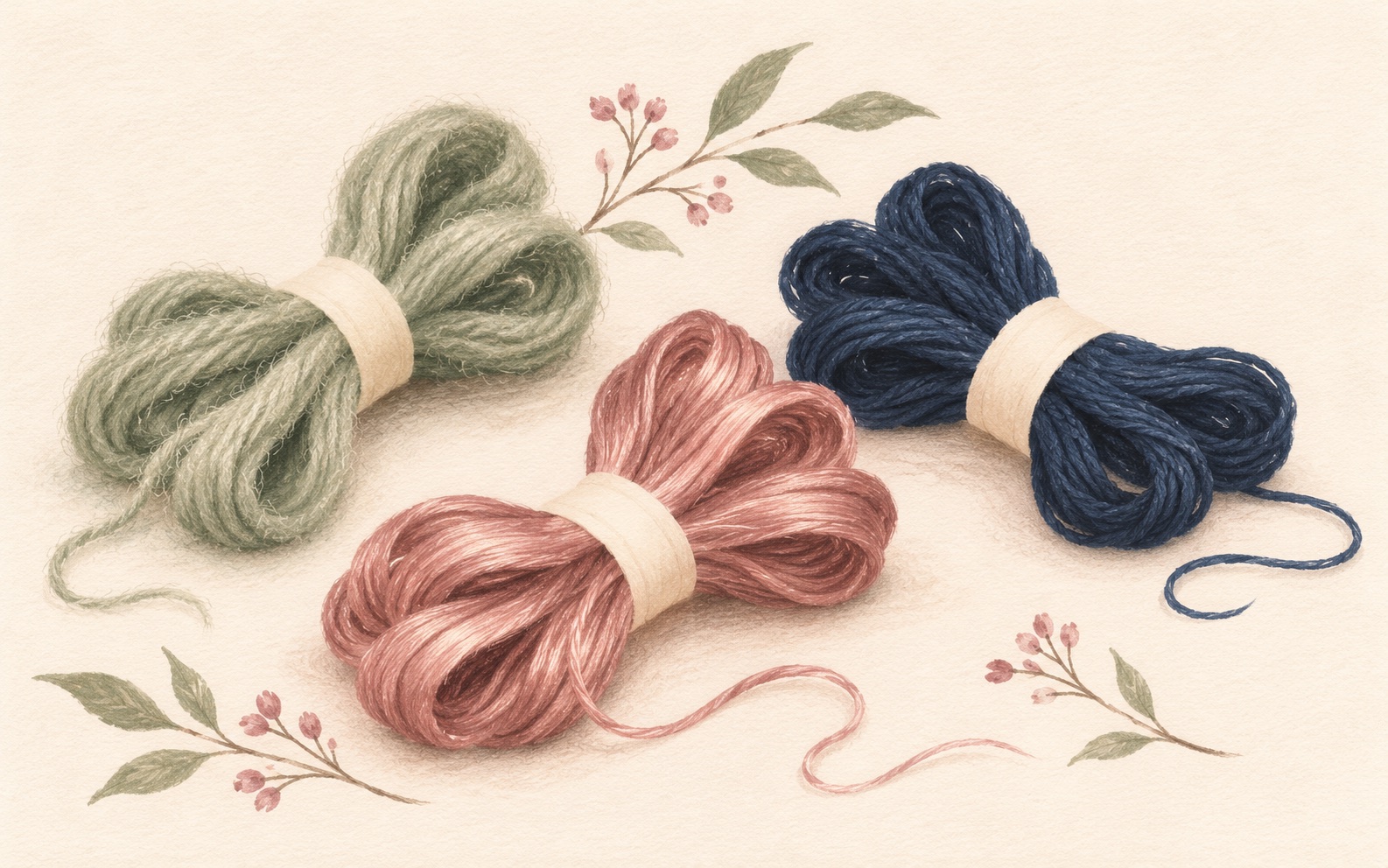
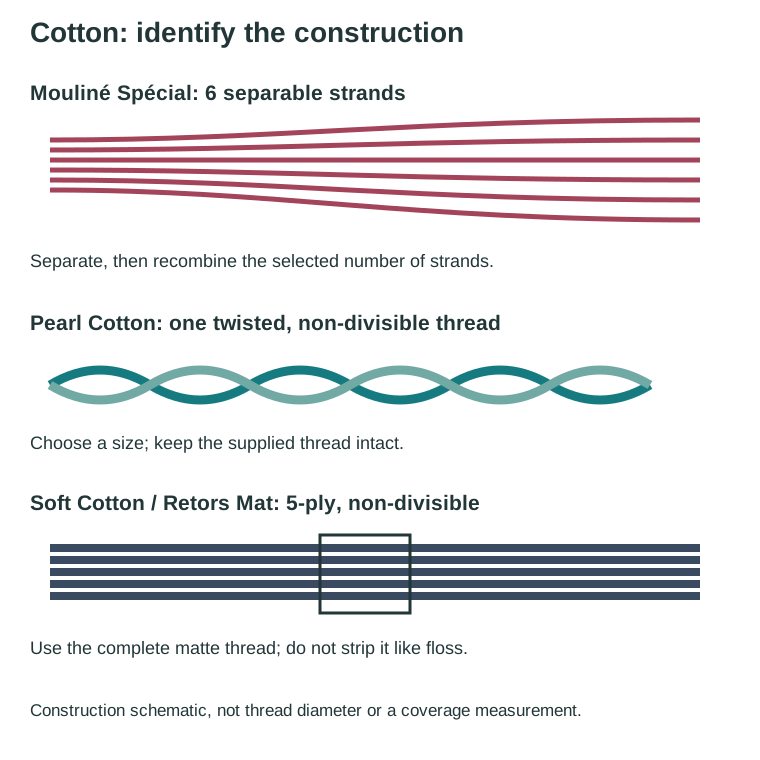
Cotton is a fiber, not a preparation instruction. DMC six-strand floss, pearl cotton, and Soft Cotton are all cotton products, but one separates into individual strands and the others are used as supplied. Choose the construction that fits the surface and handling you want.
Three products, three preparations
| Product | Construction and appearance | Preparation |
|---|---|---|
| DMC Mouliné Spécial 117MC | Six-strand 100% cotton floss | Separate individual strands, then recombine the required number |
| DMC Pearl Cotton | A twisted, non-divisible cotton thread with sheen | Choose the appropriate numbered size; use one complete length rather than untwisting it |
| DMC Soft Cotton / Retors Mat | Five-ply, non-divisible 100% long-staple cotton with a matte surface | Use the complete thread as supplied; five-ply does not mean five removable floss strands |
See DMC’s descriptions of Mouliné, Pearl Cotton, and Soft Cotton. A silky appearance is not a fiber identification: DMC’s Satin Floss, for example, is rayon rather than silk or ordinary cotton floss.
Choose a starting setup for your mesh
For a simple 13 mesh tent-stitch exercise, pearl cotton size 3 used as one undivided length is a concrete starting option in Chelsea Needlepoint’s teaching chart. The same chart suggests four individual strands of cotton floss for 18 mesh. These are starting recommendations from that teaching source, not guarantees for every stitch, canvas color, or personal tension.
For Soft Cotton, the manufacturer establishes its non-divisible matte construction but the source checked here does not establish a universal 13/18 mesh prescription. Use a kit’s specific setup or inspect a patch on the actual canvas. Do not divide Soft Cotton to imitate a finer floss bundle.
Prepare four strands of floss correctly
- Cut one working length from the six-strand floss. Hold it loosely near one end.
- Pull out one individual strand at a time while allowing the remainder to relax, rather than trying to split the bundle into two tight groups.
- Set aside two strands and bring the selected four together with their ends aligned.
- Thread the four together, leaving a short tail at the needle. A full-length loop would double the working bundle.
- After several stitches, let the needle hang briefly if the bundle has twisted, then continue without pulling hard enough to compress the canvas.
The aim is a controlled bundle of four separate strands, not a permanent rope of six with two cut away at the end. For terminology and alternatives, see stranded versus non-divisible thread.
Match the look to the area
Floss offers adjustable thickness and the option to blend individual strands of different colors. Pearl cotton keeps a visible twist that can be useful when you want a defined thread texture. Soft Cotton offers a matte alternative when a shiny surface would distract from the subject. These construction differences guide a choice; the actual stitch length and direction still affect the result.
For a fair visual comparison, use the same area shape and a named stitch such as continental. Photograph the patch beside its label. If a proposed bundle leaves unintended gaps, follow the coverage diagnostic rather than adding strands without checking resistance and tension.
Keep care instructions product-specific
DMC’s current Soft Cotton page specifies dry cleaning and says not to wash it. That is a useful counterexample to “cotton means washable.” Other thread lines may have different instructions, and a painted canvas or finished backing introduces further limits. Keep the exact product information with the work and consult the blocking decision guide before wet treatment.
Keep learning

Material
Wool thread for needlepoint
Compare Appletons crewel and tapestry wool, understand their different weights, and choose a 13 or 18 mesh starting setup without assuming interchangeability.
Material
Silk thread for needlepoint
Compare Splendor and Soie d’Alger, prepare a strandable silk, and use the maker’s 18 mesh guidance without transferring it to every silk.
Learning path
Your first needlepoint canvas: a learning path
Follow a linked beginner path from choosing a canvas and planning its finish to starting threads, stitching, and checking your first project.