
Material
Silk thread for needlepoint
Compare Splendor and Soie d’Alger, prepare a strandable silk, and use the maker’s 18 mesh guidance without transferring it to every silk.
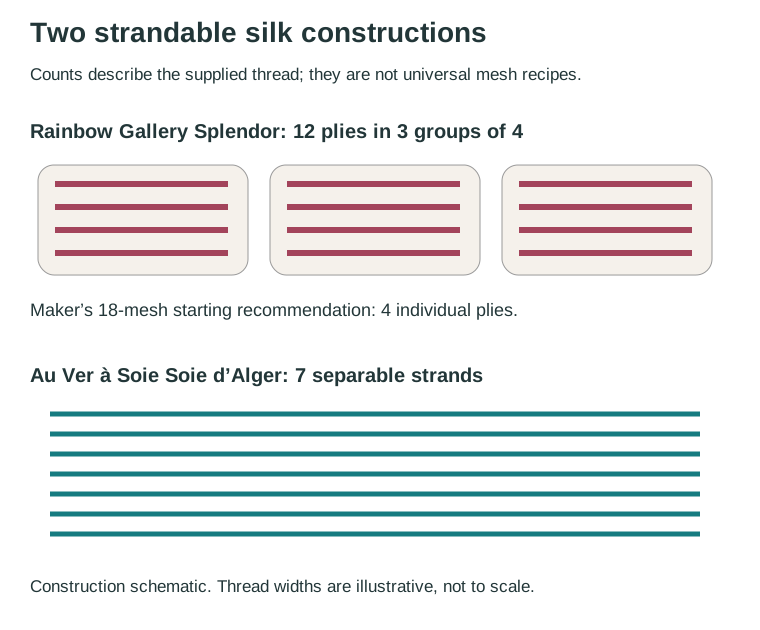
Two silk threads can both be strandable and still need different preparation. Rainbow Gallery Splendor and Au Ver à Soie Soie d’Alger show why the product name matters: their bundles, construction, and published guidance are different.
Compare the actual products
| Product | Verified construction | Useful selection point |
|---|---|---|
| Rainbow Gallery Splendor | 100% silk; 12 plies arranged as three 4-ply bundles; 8-yard cards | The maker publishes a specific four-ply needlepoint starting recommendation for 18 mesh |
| Au Ver à Soie Soie d’Alger | Seven easily separated strands of spun/combed silk; moderate sheen | A different seven-strand construction; Splendor’s four-ply recommendation is not a transferable coverage rule |
These details come from Rainbow Gallery and Au Ver à Soie. The manufacturer descriptions establish construction, not a StitchArt wear or coverage test.
Prepare Splendor for an 18 mesh trial
- Cut a manageable working length and identify the three groups of four plies. Keep the product label with the project.
- Separate the individual plies you need and recombine four evenly for the manufacturer’s 18 mesh needlepoint starting setup. Do not put all 12 plies into the needle simply because they came from one card.
- Thread the recombined length with a short tail at the eye; do not fold the full working length in half and accidentally double the number used for each stitch.
- Work a small patch in the intended stitch. Inspect how the strands sit, whether the holes remain comfortable, and how the sheen looks at normal viewing distance.
Rainbow Gallery also lists six plies for 14 mesh. That is not an exact 13 mesh specification. For 13 mesh, use the project’s recommendation or a separately checked preparation instead of relabeling the 14 mesh figure.
What changes with Soie d’Alger
Soie d’Alger begins as seven separable strands of spun silk. Select the number of individual strands needed for the actual canvas and stitch, separate them, then recombine them so they can lie together. “Seven-strand” identifies the supplied thread, not a command to use all seven for every canvas.
For a portrait with small color transitions, the separable construction lets you choose a finer preparation and combine shades deliberately. For a broad decorative fill, the required preparation may be different. This is a reason to consider the product, not evidence that a particular strand count has been tested on your canvas.
Handle sheen and snagging deliberately
Keep rough canvas edges, a damaged needle eye, and dry snagging surfaces away from the working thread. If a length becomes fuzzy or separates unevenly, replace it before filling more of a prominent area. Pull the thread through without scraping it repeatedly against a crowded hole.
Maintain the same front-stitch orientation across adjacent areas that are meant to look continuous. Light reflects differently as thread direction changes. Turn the sample under the intended room light before deciding that two patches are different dye lots. Tension checks and fraying-thread diagnosis help separate material and handling problems.
Keep the care advice with the finished piece
Follow the chosen maker’s care instructions, then account for the painted canvas, other threads, beads, and backing. A washable thread does not automatically make the entire needlepoint washable. The blocking decision guide helps you decide what information a finisher needs.
For a first silk comparison, use one stitch and one mesh, with the exact product and preparation labeled on each patch. Change product first, then assess coverage and appearance. If you also change mesh and stitch, you will be comparing complete project setups, not isolating silk construction.
Keep learning

Material
Wool thread for needlepoint
Compare Appletons crewel and tapestry wool, understand their different weights, and choose a 13 or 18 mesh starting setup without assuming interchangeability.
Material
Cotton thread for needlepoint
Compare DMC six-strand floss, pearl cotton, and Soft Cotton, with preparation differences and concrete 13/18 mesh starting choices.
Learning path
Your first needlepoint canvas: a learning path
Follow a linked beginner path from choosing a canvas and planning its finish to starting threads, stitching, and checking your first project.