
Material
Wool thread for needlepoint
Compare Appletons crewel and tapestry wool, understand their different weights, and choose a 13 or 18 mesh starting setup without assuming interchangeability.
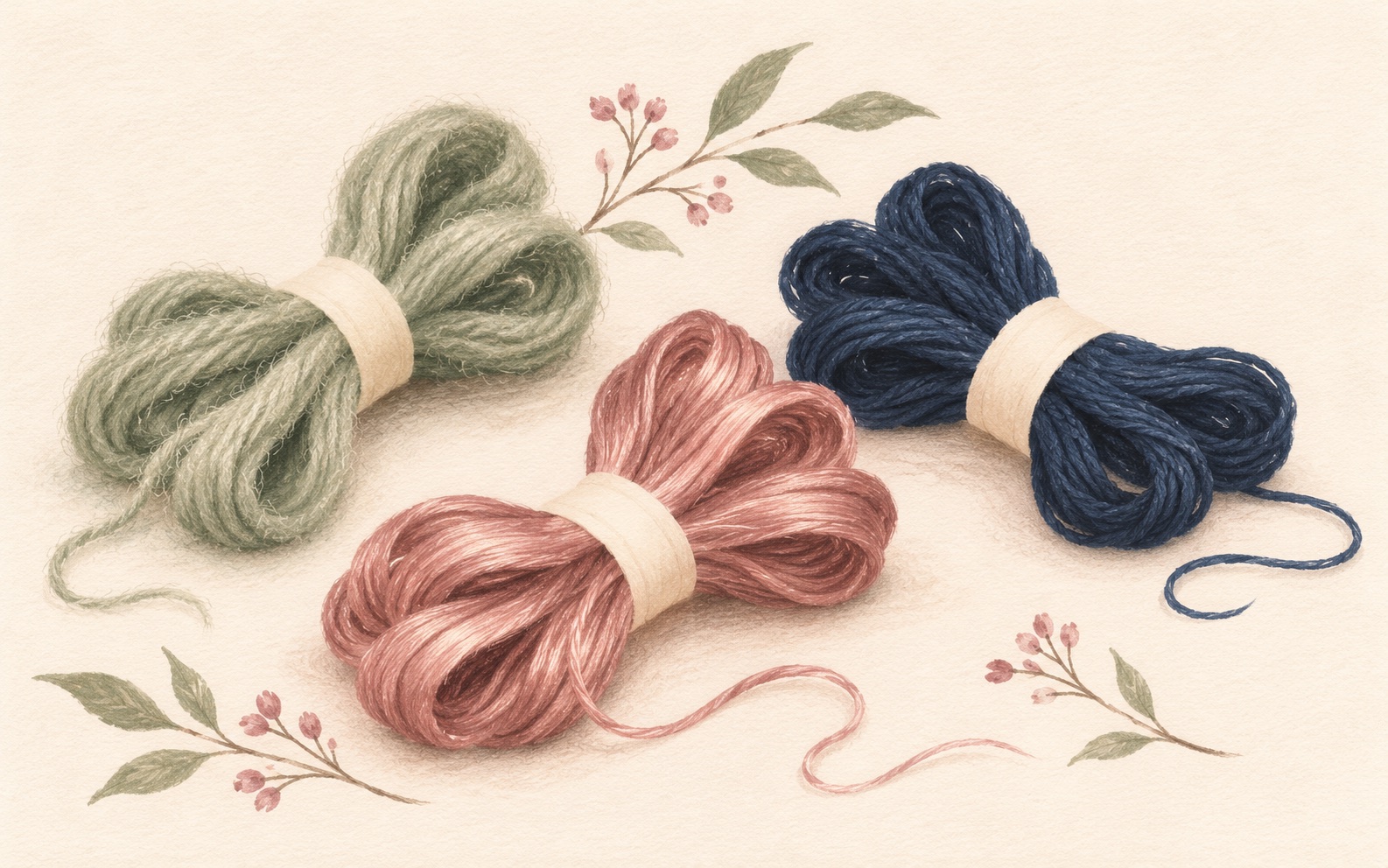
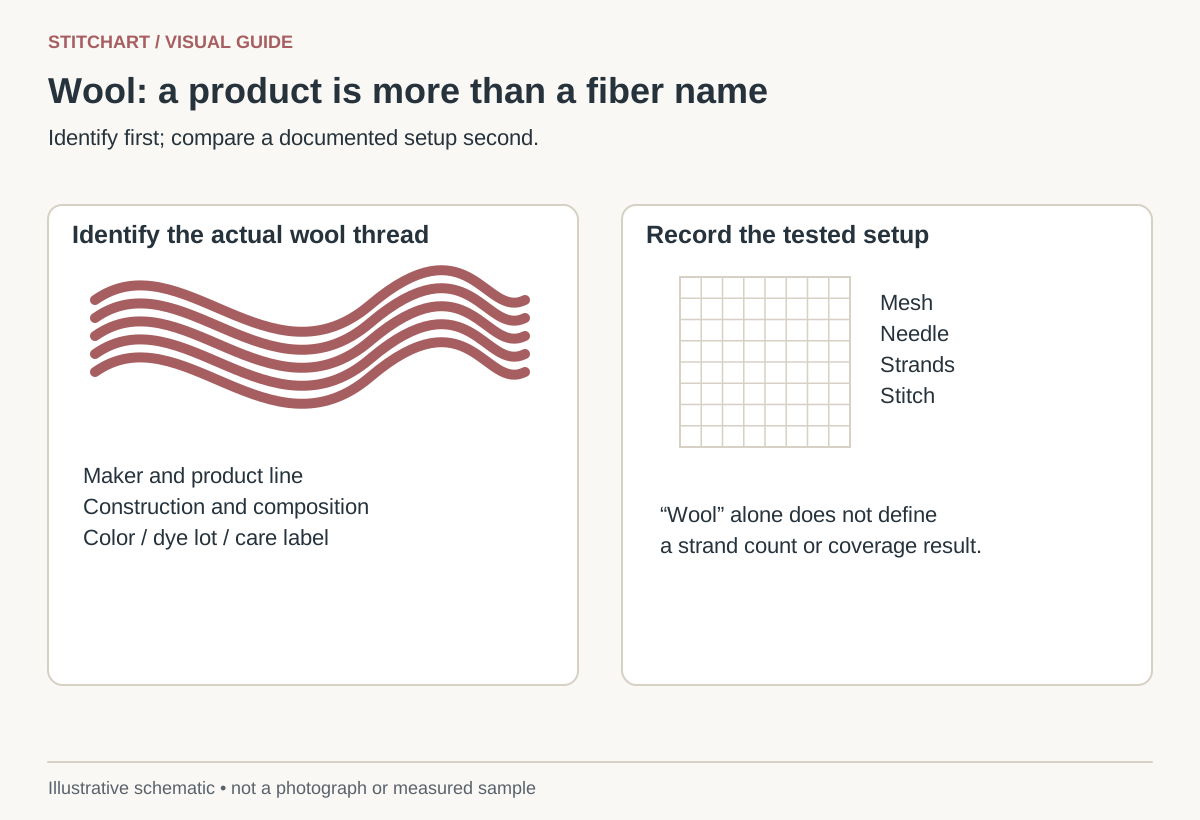
Choose a wool thread by its product line and weight, not by fiber name alone. Two pure-wool skeins can differ enough that one gives useful detail while the other crowds the same canvas. Appletons provides a clear example because it sells two weights in the same color range.
Two named wool products
| Product | Manufacturer specification | What it changes |
|---|---|---|
| Appletons Crewel Wool | 2-ply; approximately 25 m per skein | A finer complete yarn that can be combined in multiple lengths when the design calls for it |
| Appletons Tapestry Wool | 4-ply; approximately 10 m per skein | A heavier complete yarn; one skein is not the same length or weight as a crewel skein |
The constructions and approximate lengths come from Appletons’ own product FAQ. “2-ply” and “4-ply” describe how the yarn is made. They are not instructions to separate the yarn into loose plies, and they are not the number of complete lengths you must put in the needle.
What the maker says about mesh
Appletons’ weight-selection page positions crewel for canvas 14 holes per inch or finer and tapestry for 12 or coarser. That leaves 13 mesh between those stated categories. Do not silently turn a recommendation for 12 into a verified recommendation for 13. For 18 mesh, the finer crewel construction is the relevant starting family; the number of complete lengths depends on the intended stitch and coverage.
If your 13 mesh kit supplies a particular wool and instructions, begin there. When making your own substitution, compare the candidate on a small separate piece of the same canvas. Reject a setup that requires force or crushes existing stitches, even if it appears to hide more canvas.
A practical selection exercise
- Choose the stitch and finished use first. A flat tent-stitch background and a raised decorative accent ask different things of the yarn.
- For a finer-yarn option, prepare one complete length, then a separate patch with two complete lengths together if the first is visibly too light. Keep the yarn itself intact. These are comparison candidates, not prescribed universal counts.
- For a heavier option, test one undivided length and check shared holes as well as an empty grid. Do not increase bulk merely to eliminate every glint visible under an intense lamp.
- Compare the patches at ordinary viewing distance. Record comfort, unintended gaps, and the actual product used.
The two-length finer-yarn patch may allow a color blend by combining one length of each of two shades. That also changes the appearance, so keep it separate from a same-color coverage comparison. Stranded versus non-divisible thread explains the terminology.
Buy and care for the project coherently
Keep the color and lot labels when supplied, and obtain enough of the same selection for the planned area. Do not treat 25 m of a finer yarn as equivalent coverage to 25 m of a heavier yarn. Dye-lot planning and a materials test card help preserve the information you need.
Appletons advises against washing its wool, apart from necessary cold-water sponging. That statement concerns its yarn; it still does not authorize a treatment for a painted canvas or mixed-material finished object. Pass the product information to the finisher and use the pre-blocking decision guide before adding moisture.
For a broad background where you want a wool appearance but adjustable thickness, compare the finer construction first. For a bolder surface on a canvas suited to a heavier yarn, the tapestry construction is a distinct option. Make the choice from the actual setup rather than a generic rule that wool works on every mesh.
Keep learning

Material
Silk thread for needlepoint
Compare Splendor and Soie d’Alger, prepare a strandable silk, and use the maker’s 18 mesh guidance without transferring it to every silk.
Material
Cotton thread for needlepoint
Compare DMC six-strand floss, pearl cotton, and Soft Cotton, with preparation differences and concrete 13/18 mesh starting choices.
Learning path
Your first needlepoint canvas: a learning path
Follow a linked beginner path from choosing a canvas and planning its finish to starting threads, stitching, and checking your first project.